

Monkey Apolipoprotein(a) (LPA) ELISA kit

Cat# CSB-EL013044RH-10x96T
Size : 10x96T
Brand : Cusabio
Contact local distributor :

Phone : +1 850 650 7790
| Size | 96T,5×96T,10×96T |
Product Details
Target Name
lipoprotein, Lp(a)
Associated names
LPAApolipoprotein(a ELISA kit; Apo(a) ELISA kit; Lp(a) ELISA kit; EC 3.4.21.- ELISA kit; Fragment ELISA kit
Abbreviation
Uniprot No.
Species
Monkey
Sample Types
serum, plasma, tissue homogenates
Detection Range
31.25 ng/mL-2000 ng/mL
Sensitivity
15.63 ng/mL
Assay Time
1-5h
Sample Loading Volume
50-100ul
Detection Wavelength
450 nm
Research Area
Cardiovascular
Assay Principle
quantitative
Measurement
Competitive
Precision
| Intra-assay Precision (Precision within an assay): CV%<8% | |||||||
| Three samples of known concentration were tested twenty times on one plate to assess. | |||||||
| Inter-assay Precision (Precision between assays): CV%<10% | |||||||
| Three samples of known concentration were tested in twenty assays to assess. | |||||||
Typical Data
| These standard curves are provided for demonstration only. A standard curve should be generated for each set of samples assayed. | |||||||||||||||||||||||||||||||||||||||||||||||||||||||||||||||||||||||
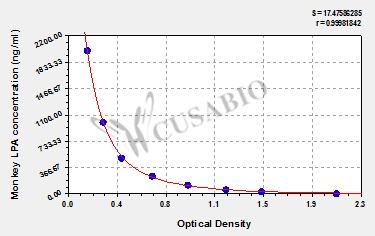
| |||||||||||||||||||||||||||||||||||||||||||||||||||||||||||||||||||||||
ELISA Data Analysis
Troubleshooting
and FAQs
and FAQs
Storage
Store at 2-8°C. Please refer to protocol.
Shelf Life
6 months
Description
This Monkey LPA ELISA Kit was designed for the quantitative measurement of Monkey LPA protein in serum, plasma, tissue homogenates. It is a Competitive ELISA kit, its detection range is 31.25 ng/mL-2000 ng/mL and the sensitivity is 15.63 ng/mL.
Customer Reviews and Q&A
There are currently no reviews for this product.
Target Background
Function
(From Uniprot)
(From Uniprot)
Apo(a) is the main constituent of lipoprotein(a) (Lp(a)). It has serine proteinase activity and is able of autoproteolysis. Inhibits tissue-type plasminogen activator 1. Lp(a) may be a ligand for megalin/Gp 330.
Involvement in disease
Elevated plasma concentrations of apo(a) and its naturally occurring proteolytic fragments are correlated with atherosclerosis. Homology with plasminogen kringles IV and V is thought to underlie the atherogenicity of the protein, because the fragments are competing with plasminogen for fibrin(ogen) binding.
Protein Families
Peptidase S1 family, Plasminogen subfamily
Database Links
STRING:
UniGene: