ITGAL Antibody

Cat# OAEE00609
Size : 100tests(T100)
Brand : Aviva Systems Biology
Contact local distributor :

Phone : +1 850 650 7790

| Datasheets/Manuals | Printable datasheet for ITGAL Antibody |
|---|
| Predicted Species Reactivity | Human |
|---|---|
| Product Format | Stabilizing phosphate buffered saline (PBS), pH 7.4, 15 mM sodium azide |
| Clonality | Monoclonal |
| Clone | MEM-25 |
| Isotype | IgG1 |
| Host | Mouse |
| Conjugation | R-PE |
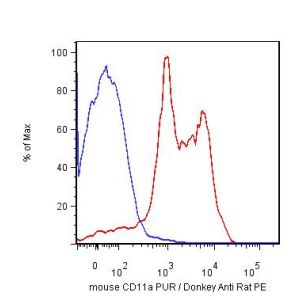
| Application | FC |
| Reconstitution and Storage | 2°C to 8°C |
| Immunogen | Leukocytes from a patient suffering from a LGL-type leukaemia. |
| Purification | Purified by size-exclusion chromatography |
| Concentration | 20 ul / test |
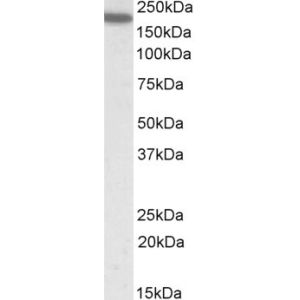
| Specificity | The antibody MEM-25 reacts with CD11a (alpha subunit of human LFA-1), a 170-180 kDa type I transmembrane glycoprotein expressed on B and T lymphocytes, monocytes, macrophages, neutrophils, basophils and eosinophils. HLDA IV; WS Code NL 209 |
| Formulation | PE |
| Storage Buffer | The reagent is provided in phosphate buffered saline (PBS) containing 15 mM sodium azide and 0.2% (w/v) high-grade protease free Bovine Serum Albumin (BSA) as a stabilizing agent. |
| Reference | Aubert M, Yoon M, Sloan DD, Spear PG, Jerome KR: The virological synapse facilitates herpes simplex virus entry into T cells. J Virol. 2009 Jun;83(12):6171-83. Ottonello L, Epstein AL, Dapino P, Barbera P, Morone P, Dallegri F: Monoclonal Lym-1 antibody-dependent cytolysis by neutrophils exposed to granulocyte-macrophage colony-stimulating factor: intervention of FcgammaRII (CD32), CD11b-CD18 integrins, and CD66b glycoproteins. Blood. 1999 May 15;93(10):3505-11. Mathison RD, Befus AD, Davison JS, Woodman RC: Modulation of neutrophil function by the tripeptide feG. BMC Immunol. 2003 Mar 4;4:3. Epub 2003 Mar 4. Garnotel R, Rittié L, Poitevin S, Monboisse JC, Nguyen P, Potron G, Maquart FX, Randoux A, Gillery P: Human blood monocytes interact with type I collagen through alpha x beta 2 integrin (CD11c-CD18, gp150-95). J Immunol. 2000 Jun 1;164(11):5928-34. Wang JH, Kwas C, Wu L: Intercellular adhesion molecule 1 (ICAM-1), but not ICAM-2 and -3, is important for dendritic cell-mediated human immunodeficiency virus type 1 transmission. J Virol. 2009 May;83(9):4195-204. Hajishengallis G, Martin M, Sojar HT, Sharma A, Schifferle RE, DeNardin E, Russell MW, Genco RJ: Dependence of bacterial protein adhesins on toll-like receptors forproinflammatory cytokine induction. Clin Diagn Lab Immunol. 2002 Mar;9(2):403-11. Simon SI, Cherapanov V, Nadra I, Waddell TK, Seo SM, Wang Q, Doerschuk CM, Downey GP: Signaling functions of L-selectin in neutrophils: alterations in the cytoskeletonand colocalization with CD18. J Immunol. 1999 Sep 1;163(5):2891-901. Ottonello L, Epstein AL, Mancini M, Dapino P, Dallegri F: Monoclonal LYM-1 antibody-dependent cytolysis by human neutrophils exposed to GM-CSF: auto-regulation of target cell attack by cathepsin G. J Leukoc Biol. 2004 Jan;75(1):99-105. Leukocyte Typing IV., Knapp W. et al. (Eds.), Oxford University Press (1989). Bazil V, Stefanova I, Hilgert I, Kristofova H, Vanek S, Horejsi V.: Monoclonal antibodies against human leucocyte antigens. IV. Antibodies against subunits of the LFA-1 (CD11a/CD18) leucocyte-adhesion glycoprotein. Folia Biol (Praha). 1990;36(1):41-50. Fujii T, Takada-Takatori Y, Kawashima K: Roles played by lymphocyte function-associated antigen-1 in the regulation of lymphocytic cholinergic activity. Life Sci. 2007 May 30;80(24-25):2320-4. Kellersch B, Kolanus W: Membrane-proximal signaling events in beta-2 integrin activation. Results Probl Cell Differ. 2006;43:245-57. Giblin PA, Lemieux RM: LFA-1 as a key regulator of immune function: approaches toward the development ofLFA-1-based therapeutics. Curr Pharm Des. 2006;12(22):2771-95. Sarantos MR, Raychaudhuri S, Lum AF, Staunton DE, Simon SI: Leukocyte function-associated antigen 1-mediated adhesion stability is dynamically regulated through affinity and valency during bond formation withintercellular adhesion molecule-1. J Biol Chem. 2005 Aug 5;280(31):28290-8. |
|---|---|
| Gene Symbol | ITGAL |
| Gene Full Name | integrin subunit alpha L |
| Alias Symbols | antigen CD11A (p180), lymphocyte function-associated antigen 1, alpha polypeptide, CD11 antigen-like family member A, CD11A, integrin alpha-L, integrin gene promoter, integrin, alpha L (antigen CD11A (p180), lymphocyte function-associated antigen 1; alpha polypeptide), leukocyte adhesion glycoprotein LFA-1 alpha chain, leukocyte function-associated molecule 1 alpha chain, LFA-1, LFA-1 alpha, LFA-1A, LFA1A, lymphocyte function-associated antigen 1, alpha polypeptide. |
| NCBI Gene Id | 3683 |
| Protein Name | Integrin alpha-L |
| Description of Target | Integrin alpha-L/beta-2 is a receptor for ICAM1, ICAM2, ICAM3 and ICAM4. Integrin alpha-L/beta-2 is also a receptor for F11R (PubMed:11812992, PubMed:15528364). Involved in a variety of immune phenomena including leukocyte-endothelial cell interaction, cytotoxic T-cell mediated killing, and antibody dependent killing by granulocytes and monocytes. Contributes to natural killer cell cytotoxicity (PubMed:15356110). Involved in leukocyte adhesion and transmigration of leukocytes including T-cells and neutrophils (PubMed:11812992). Required for generation of common lymphoid progenitor cells in bone marrow, indicating a role in lymphopoiesis (By similarity). Integrin alpha-L/beta-2 in association with ICAM3, contributes to apoptotic neutrophil phagocytosis by macrophages (PubMed:23775590). |
| Uniprot ID | P20701 |
| Protein Accession # | NP_001107852.1; NP_002200.2 |
| Nucleotide Accession # | NM_001114380.1; NM_002209.2 |