
Human LCP2 Antibody : APC (Phospho-Tyr128)

Cat# OAAQ00099-10tests
Size : 10Tests
Brand : Aviva Systems Biology
Contact local distributor :

Phone : +1 850 650 7790
Human LCP2 Antibody : APC (Phospho-Tyr128)
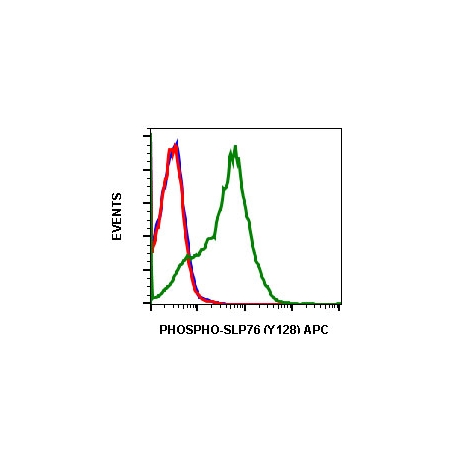
Human LCP2 Antibody : APC (Phospho-Tyr128) (OAAQ00099)
| Datasheets/Manuals | Printable datasheet for OAAQ00099 |
|---|
| Tested Species Reactivity | Human, Mouse |
|---|---|
| Predicted Species Reactivity | Mouse, Rat |
| Product Format | Liquid. 1X PBS, 0.09% NaN3, 0.2% BSA. |
| Clonality | Monoclonal |
| Clone | SLP76Y128-3F8 |
| Isotype | Rabbit IgG1k |
| Host | Rabbit |
| Conjugation | APC: Allophycocyanin |
| Application | FC |
| Reconstitution and Storage | 2-8C |
| Immunogen | A synthetic phospho-peptide corresponding to residues surrounding Tyr128 of human phospho SLP-76 |
| Purification | Protein A+G |
| Target Post-Translational Modification | Phospho-Tyr128 |
| Application Info | For flow cytometric staining, the suggested use of this reagent is 5 uL per million cells or 5 uL per 100 uL of staining volume. It is recommended that the reagent be titrated for optimal performance for each application. |
| Reference | Zhang MS, Tran PM, Wolff AJ, Tremblay MM, Fosdick MG, and Houtman JCD. (2018) Science Signaling. 11:eaam9095. Yablonski D, Kuhne MR, Kadlecek T, and Weiss A. (1998) Science. 281:413-416. Thaker YR, Recino A, Raab M, Jabeen A, Wallberg M, Fernandez N, and Rudd CE. (2017) Journal of Biological Chemistry. 292:6281-6290. |
|---|---|
| Gene Symbol | LCP2 |
| Gene Full Name | lymphocyte cytosolic protein 2 |
| Alias Symbols | SLP76, SLP-76 |
| NCBI Gene Id | 3937 |
| Protein Name | lymphocyte cytosolic protein 2 |
| Description of Target | This gene encodes an adapter protein that acts as a substrate of the T cell antigen receptor (TCR)-activated protein tyrosine kinase pathway. The encoded protein associates with growth factor receptor bound protein 2, and is thought to play a role TCR-mediated intracellular signal transduction. A similar protein in mouse plays a role in normal T-cell development and activation. Mice lacking this gene show subcutaneous and intraperitoneal fetal hemorrhaging, dysfunctional platelets and impaired viability. |
| Uniprot ID | Q13094 |
| Protein Accession # | NP_005556.1 |
| Nucleotide Accession # | NM_005565.4 |