

Human HIF-1alpha (Hypoxia Inducible Factor 1 Alpha) CLIA Kit

Cat# MBS2532280-5x96
Size : 5x96Tests
Brand : MyBiosource
Contact local distributor :
 Phone : +1 850 650 7790
HIF-1alpha (Hypoxia Inducible Factor 1 Alpha) (HIF-1a) CLIA Kit for Human
For Research Use Only. Not for use in diagnostic procedures. Catalog #: MBS2532280Intended Uses: This CLIA kit applies to the in vitro quantitative determination of HIF-1alpha concentrations in serum, plasma and other biological fluids.Principle of the Assay||This kit uses Sandwich-CLIA as the method. The micro CLIA plate provided in this… More details
Product Overview
Product Name
HIF-1alpha (Hypoxia Inducible Factor 1 Alpha), CLIA Kit
Full Product Name
Human HIF-1alpha (Hypoxia Inducible Factor 1 Alpha) CLIA Kit
Product Gene Name
HIF-1a clia kit
Product Synonym Names
HIF1A; HIF-1A; MOP1; PASD8; bHLHe78; basic helix-loop-helix transcription factor; Human HIF-1a (Hypoxia Inducible Factor 1 Alpha) CLIA Kit; Human HIF-1a
Species Reactivity
Human
Assay Type
Sandwich
Detection Range
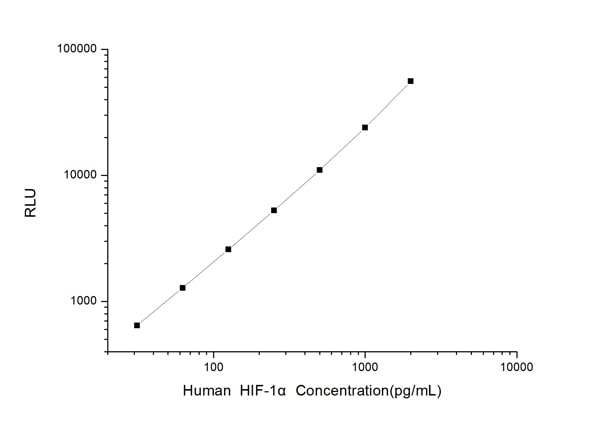
31.25-2000pg/mL
Sensitivity
Min: 18.75pg/mL; Max: 2000pg/mL
Specificity
This kit recognizes natural and recombinant HIF-1alpha. No significant cross-reactivity or interference between HIF-1alpha and analogues was observed.
Molecular Weight
95,634 Da
OMIM
603348
ISO Certification
Manufactured in an ISO 9001:2015 Certified Laboratory.
Other Notes
Small volumes of HIF-1a clia kit vial(s) may occasionally become entrapped in the seal of the product vial during shipment and storage. If necessary, briefly centrifuge the vial on a tabletop centrifuge to dislodge any liquid in the container`s cap. Certain products may require to ship with dry ice and additional dry ice fee may apply.
Searchable Terms for HIF-1a purchase
MBS2532280 is a CLIA kit targeting HIF-1a. Also known as Human HIF-1alpha (Hypoxia Inducible Factor 1 Alpha) CLIA Kit. Reactive in Human.
Additional Details
NCBI/Uniprot data below describe general gene information for HIF-1a. It may not necessarily be applicable to this product.
NCBI Official Full Name
hypoxia-inducible factor 1-alpha isoform 1
NCBI Official Synonym Full Names
hypoxia inducible factor 1, alpha subunit (basic helix-loop-helix transcription factor)
NCBI Official Symbol
HIF1A
NCBI Official Synonym Symbols
HIF1; MOP1; PASD8; HIF-1A; bHLHe78; HIF-1alpha; HIF1-ALPHA; HIF-1-alpha
UniProt Protein Name
Hypoxia-inducible factor 1-alpha
UniProt Synonym Protein Names
ARNT-interacting protein; Basic-helix-loop-helix-PAS protein MOP1; Class E basic helix-loop-helix protein 78; bHLHe78; Member of PAS protein 1; PAS domain-containing protein 8
UniProt Gene Name
HIF1A
UniProt Synonym Gene Names
BHLHE78; MOP1; PASD8; HIF-1-alpha; HIF1-alpha; bHLHe78
UniProt Entry Name
HIF1A_HUMAN
NCBI Protein Information
hypoxia-inducible factor 1-alpha
NCBI Summary for HIF-1a
This gene encodes the alpha subunit of transcription factor hypoxia-inducible factor-1 (HIF-1), which is a heterodimer composed of an alpha and a beta subunit. HIF-1 functions as a master regulator of cellular and systemic homeostatic response to hypoxia by activating transcription of many genes, including those involved in energy metabolism, angiogenesis, apoptosis, and other genes whose protein products increase oxygen delivery or facilitate metabolic adaptation to hypoxia. HIF-1 thus plays an essential role in embryonic vascularization, tumor angiogenesis and pathophysiology of ischemic disease. Alternatively spliced transcript variants encoding different isoforms have been identified for this gene. [provided by RefSeq, Jul 2011]
Show more UniProt Comments for HIF-1a
HIF1A: a master transcriptional regulator of the adaptive response to hypoxia. Under hypoxic conditions, activates the transcription of over 40 genes, including erythropoietin, glucose transporters, glycolytic enzymes, vascular endothelial growth factor, HILPDA, and other genes whose protein products increase oxygen delivery or facilitate metabolic adaptation to hypoxia. Plays an essential role in embryonic vascularization, tumor angiogenesis and pathophysiology of ischemic disease. Binds to core DNA sequence 5'-[AG]CGTG-3' within the hypoxia response element (HRE) of target gene promoters. Activation requires recruitment of transcriptional coactivators such as CREBPB and EP300. Activity is enhanced by interaction with both, NCOA1 or NCOA2. Interaction with redox regulatory protein APEX seems to activate CTAD and potentiates activation by NCOA1 and CREBBP. Involved in the axonal distribution and transport of mitochondria in neurons during hypoxia. Interacts with the HIF1A beta/ARNT subunit; heterodimerization is required for DNA binding. Interacts with COPS5; the interaction increases the transcriptional activity of HIF1A through increased stability. Interacts with EP300 (via TAZ-type 1 domains); the interaction is stimulated in response to hypoxia and inhibited by CITED2. Interacts with CREBBP (via TAZ-type 1 domains). Interacts with NCOA1, NCOA2, APEX and HSP90. Interacts (hydroxylated within the ODD domain) with VHLL (via beta domain); the interaction, leads to polyubiquitination and subsequent HIF1A proteasomal degradation. During hypoxia, sumoylated HIF1A also binds VHL; the interaction promotes the ubiquitination of HIF1A. Interacts with SENP1; the interaction desumoylates HIF1A resulting in stabilization and activation of transcription. Interacts (Via the ODD domain) with ARD1A; the interaction appears not to acetylate HIF1A nor have any affect on protein stability, during hypoxia. Interacts with RWDD3; the interaction enhances HIF1A sumoylation. Interacts with TSGA10. Interacts with RORA (via the DNA binding domain); the interaction enhances HIF1A transcription under hypoxia through increasing protein stability. Interaction with PSMA7 inhibits the transactivation activity of HIF1A under both normoxic and hypoxia- mimicking conditions. Interacts with USP20. Interacts with RACK1; promotes HIF1A ubiquitination and proteasome- mediated degradation. Interacts (via N-terminus) with USP19. Under reduced oxygen tension. Induced also by various receptor-mediated factors such as growth factors, cytokines, and circulatory factors such as PDGF, EGF, FGF2, IGF2, TGFB1, HGF, TNF, IL1B, angiotensin-2 and thrombin. However, this induction is less intense than that stimulated by hypoxia. Repressed by HIPK2 and LIMD1. Expressed in most tissues with highest levels in kidney and heart. Overexpressed in the majority of common human cancers and their metastases, due to the presence of intratumoral hypoxia and as a result of mutations in genes encoding oncoproteins and tumor suppressors. 2 isoforms of the human protein are produced by alternative splicing.
Protein type: Transcription factor; Autophagy; DNA-binding
Chromosomal Location of Human Ortholog: 14q23.2
Cellular Component: nucleoplasm; transcription factor complex; cytoplasm; nucleolus; nuclear speck; nucleus; cytosol
Molecular Function: RNA polymerase II transcription factor activity, enhancer binding; histone deacetylase binding; Hsp90 protein binding; protein kinase binding; transcription factor binding; histone acetyltransferase binding; protein binding; enzyme binding; protein heterodimerization activity; sequence-specific DNA binding; ubiquitin protein ligase binding; transcription factor activity; nuclear hormone receptor binding
Biological Process: lactation; oxygen homeostasis; response to muscle activity; embryonic placenta development; cellular iron ion homeostasis; positive regulation of transcription, DNA-dependent; signal transduction; glucose homeostasis; positive regulation of vascular endothelial growth factor receptor signaling pathway; muscle maintenance; negative regulation of bone mineralization; connective tissue replacement during inflammatory response; elastin metabolic process; axon transport of mitochondrion; regulation of transcription, DNA-dependent; visual learning; angiogenesis; heart looping; regulation of transcription from RNA polymerase II promoter in response to oxidative stress; neural crest cell migration; negative regulation of growth; hemoglobin biosynthetic process; positive regulation of neuroblast proliferation; Notch signaling pathway; regulation of transforming growth factor-beta2 production; negative regulation of TOR signaling pathway; collagen metabolic process; embryonic hemopoiesis; positive regulation of erythrocyte differentiation; positive regulation of nitric-oxide synthase activity; B-1 B cell homeostasis; digestive tract morphogenesis; mRNA transcription from RNA polymerase II promoter; positive regulation of chemokine production; positive regulation of angiogenesis; neural fold elevation formation; regulation of gene expression; positive regulation of hormone biosynthetic process; cartilage development; lactate metabolic process; positive regulation of glycolysis; response to hypoxia; epithelial to mesenchymal transition; positive regulation of endothelial cell proliferation; positive regulation of transcription from RNA polymerase II promoter; cerebral cortex development
Show more Protein type: Transcription factor; Autophagy; DNA-binding
Chromosomal Location of Human Ortholog: 14q23.2
Cellular Component: nucleoplasm; transcription factor complex; cytoplasm; nucleolus; nuclear speck; nucleus; cytosol
Molecular Function: RNA polymerase II transcription factor activity, enhancer binding; histone deacetylase binding; Hsp90 protein binding; protein kinase binding; transcription factor binding; histone acetyltransferase binding; protein binding; enzyme binding; protein heterodimerization activity; sequence-specific DNA binding; ubiquitin protein ligase binding; transcription factor activity; nuclear hormone receptor binding
Biological Process: lactation; oxygen homeostasis; response to muscle activity; embryonic placenta development; cellular iron ion homeostasis; positive regulation of transcription, DNA-dependent; signal transduction; glucose homeostasis; positive regulation of vascular endothelial growth factor receptor signaling pathway; muscle maintenance; negative regulation of bone mineralization; connective tissue replacement during inflammatory response; elastin metabolic process; axon transport of mitochondrion; regulation of transcription, DNA-dependent; visual learning; angiogenesis; heart looping; regulation of transcription from RNA polymerase II promoter in response to oxidative stress; neural crest cell migration; negative regulation of growth; hemoglobin biosynthetic process; positive regulation of neuroblast proliferation; Notch signaling pathway; regulation of transforming growth factor-beta2 production; negative regulation of TOR signaling pathway; collagen metabolic process; embryonic hemopoiesis; positive regulation of erythrocyte differentiation; positive regulation of nitric-oxide synthase activity; B-1 B cell homeostasis; digestive tract morphogenesis; mRNA transcription from RNA polymerase II promoter; positive regulation of chemokine production; positive regulation of angiogenesis; neural fold elevation formation; regulation of gene expression; positive regulation of hormone biosynthetic process; cartilage development; lactate metabolic process; positive regulation of glycolysis; response to hypoxia; epithelial to mesenchymal transition; positive regulation of endothelial cell proliferation; positive regulation of transcription from RNA polymerase II promoter; cerebral cortex development
Precautions
All of MyBioSource's Products are for scientific laboratory research purposes and are not for diagnostic, therapeutics, prophylactic or in vivo use. Through your purchase, you expressly represent and warrant to MyBioSource that you will properly test and use any Products purchased from MyBioSource in accordance with industry standards. MyBioSource and its authorized distributors reserve the right to refuse to process any order where we reasonably believe that the intended use will fall outside of our acceptable guidelines.
Disclaimer
While every efforts were made to ensure the accuracy of the information provided in this datasheet, MyBioSource will not be liable for any omissions or errors contained herein. MyBioSource reserves the right to make changes to this datasheet at any time without prior notice.
It is the responsibility of the customer to report product performance issues to MyBioSource within 30 days of receipt of the product. Please visit our Terms & Conditions page for more information.
It is the responsibility of the customer to report product performance issues to MyBioSource within 30 days of receipt of the product. Please visit our Terms & Conditions page for more information.
Product Note
Select online data sheet information is drawn from bioinformatics databases, occasionally resulting in ambiguous or non-relevant product information. It is the responsibility of the customer to review, verify, and evaluate the information to make sure it matches their requirements before purchasing the kit. Our ELISA Kit assays are dynamic research tools and sometimes they may be updated and improved. If the format of this assay is important to you then please request the current manual or contact our technical support team with a presales inquiry before placing an order. We will confirm the current details of the assay. We cannot guarantee the sample manual posted online is the most current manual, it is intended to serve as an example only. Please refer to the instructions For Use provided with the assay kit for precise details.
Product PubMed Publications
Products associated with HIF-1a clia kit
| Reference Product | PubMed Publications |
|---|---|
| VHL clia kit | >555 publications with HIF-1a and VHL |
| ARNT clia kit | >301 publications with HIF-1a and ARNT |
| EGLN1 clia kit | >156 publications with HIF-1a and EGLN1 |
| EGLN3 clia kit | >70 publications with HIF-1a and EGLN3 |
| HIF1AN clia kit | >63 publications with HIF-1a and HIF1AN |
| EP300 clia kit | >31 publications with HIF-1a and EP300 |
| CREBBP clia kit | >15 publications with HIF-1a and CREBBP |
| UBC clia kit | >6 publications with HIF-1a and UBC |
| HSP90AA1 clia kit | >3 publications with HIF-1a and HSP90AA1 |
| TCEB1 clia kit | >2 publications with HIF-1a and TCEB1 |
Pathways associated with HIF-1a clia kit
| Products by Pathway | Pathway Diagram |
|---|---|
| AGE/RAGE Pathway antibodies | AGE/RAGE Pathway Diagram |
| Adipogenesis Pathway antibodies | Adipogenesis Pathway Diagram |
| Angiogenesis Pathway antibodies | Angiogenesis Pathway Diagram |
| BMAL1:CLOCK,NPAS2 Activates Circadian Gene Expression Pathway antibodies | BMAL1:CLOCK,NPAS2 Activates Circadian Gene Expression Pathway Diagram |
| Cellular Response To Hypoxia Pathway antibodies | Cellular Response To Hypoxia Pathway Diagram |
| Cellular Responses To Stress Pathway antibodies | Cellular Responses To Stress Pathway Diagram |
| Central Carbon Metabolism In Cancer Pathway antibodies | Central Carbon Metabolism In Cancer Pathway Diagram |
| Central Carbon Metabolism In Cancer Pathway antibodies | Central Carbon Metabolism In Cancer Pathway Diagram |
| Choline Metabolism In Cancer Pathway antibodies | Choline Metabolism In Cancer Pathway Diagram |
| Choline Metabolism In Cancer Pathway antibodies | Choline Metabolism In Cancer Pathway Diagram |
Organs/Tissues associated with HIF-1a clia kit
| Organ/Tissue Name | Pubmed Publications |
|---|---|
| Vascular Antibodies | >3654 publications with HIF-1a and Vascular |
| Blood Antibodies | >2163 publications with HIF-1a and Blood |
| Brain Antibodies | >835 publications with HIF-1a and Brain |
| Muscle Antibodies | >828 publications with HIF-1a and Muscle |
| Kidney Antibodies | >778 publications with HIF-1a and Kidney |
| Lung Antibodies | >711 publications with HIF-1a and Lung |
| Liver Antibodies | >678 publications with HIF-1a and Liver |
| Heart Antibodies | >621 publications with HIF-1a and Heart |
| Bone Antibodies | >502 publications with HIF-1a and Bone |
| Prostate Antibodies | >309 publications with HIF-1a and Prostate |