

Human Abeta42 (Amyloid Beta 42) ELISA Kit

Cat# MBS2506592-24
Size : 24Tests(LIMIT1)
Brand : MyBiosource
Contact local distributor :

Phone : +1 850 650 7790
Abeta42 ELISA Kit for Human
For Research Use Only. Not for use in diagnostic procedures. Special Promotion Catalog #: MBS2506592SPECIAL PROMOTIONAL PRICING for a limited time
Principle of the Assay: This ELISA kit uses the Sandwich-ELISA principle. The micro ELISA plate provided in this kit has been pre-coated with an antibody specific to Human Abeta1-42. Standards or samples are added to the micro ELISA plate wells and combined… More details
Product Overview
Online Datasheet in PDFProduct Name
Abeta42, ELISA Kit
Full Product Name
Human Abeta42 (Amyloid Beta 42) ELISA Kit
Product Gene Name
Abeta42 elisa kit
Species Reactivity
Human
Assay Type
Quantitative Sandwich
Samples
Serum, plasma and other biological fluids
Detection Range
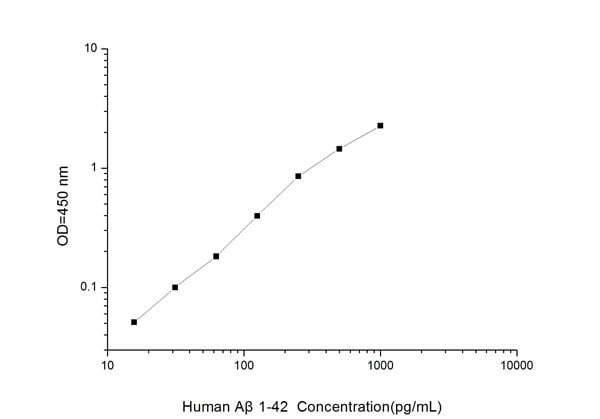
15.63-1000pg/mL
Sensitivity
9.38pg/mL
Specificity
This kit recognizes Human Abeta1-42 in samples. No significant cross-reactivity or interference between Human Abeta1-42 and analogues was observed.
Preparation and Storage
Store at 4 degree C.
Inter-assay Precision
Inter-assay Precision (Precision between assays): 3 samples with low, mid range and high level Human Abeta1-42 were tested on 3 different plates, 20 replicates in each plate.
Intra-assay Precision
Intra-assay Precision (Precision within an assay): 3 samples with low, mid range and high level Human Abeta1-42 were tested 20 times on one plate, respectively.
Molecular Weight
– Da
ISO Certification
Manufactured in an ISO 9001:2015 Certified Laboratory.
Other Notes
Small volumes of Abeta42 elisa kit vial(s) may occasionally become entrapped in the seal of the product vial during shipment and storage. If necessary, briefly centrifuge the vial on a tabletop centrifuge to dislodge any liquid in the container`s cap. Certain products may require to ship with dry ice and additional dry ice fee may apply.
Searchable Terms for Abeta42 purchase
MBS2506592 is a ready-to-use microwell, strip-or-full plate ELISA (enzyme-linked immunosorbent assay) Kit for analyzing the presence of the Abeta42, ELISA Kit target analytes in biological samples. The concentration gradients of the kit standards or positive controls render a theoretical kit detection range in biological research samples containing Abeta42. The ELISA analytical biochemical technique of the MBS2506592 kit is based on Abeta42 antibody-Abeta42 antigen interactions (immunosorbency) and an HRP colorimetric detection system to detect Abeta42 antigen targets in samples. The ELISA Kit is designed to detect native, not recombinant, Abeta42. Appropriate sample types may include undiluted body fluids and/or tissue homogenates, secretions. Quality control assays assessing reproducibility identified the intra-assay CV (%) and inter-assay CV(%).
Additional Details
NCBI/Uniprot data below describe general gene information for Abeta42. It may not necessarily be applicable to this product.
UniProt Primary Accession #
UniProt Secondary Accession #
UniProt Related Accession #
GenBank Nucleotide #
NCBI Official Full Name
amyloid beta A4 protein
NCBI Official Synonym Full Names
amyloid beta (A4) precursor protein
NCBI Official Symbol
App
NCBI Official Synonym Symbols
Abeta
UniProt Protein Name
Amyloid beta A4 protein
UniProt Synonym Protein Names
ABPP; APP; Alzheimer disease amyloid A4 protein homolog; Amyloidogenic glycoprotein; AG
UniProt Gene Name
App
UniProt Synonym Gene Names
APP; AG; S-APP-alpha; S-APP-beta
UniProt Entry Name
A4_RAT
NCBI Protein Information
amyloid beta A4 protein; ABPP; AG; alzheimer disease amyloid A4 protein homolog; amyloidogenic glycoprotein
NCBI Summary for Abeta42
activates voltage dependent calcium channels; may induce neuronal apoptosis [RGD, Feb 2006]
UniProt Comments for Abeta42
APP: a cell surface receptor that influences neurite growth, neuronal adhesion and axonogenesis. Cleaved by secretases to form a number of peptides, some of which bind to the acetyltransferase complex Fe65/TIP60 to promote transcriptional activation. The Abeta peptide is released from the cell, its extracellular deposition and accumulation form the main components of amyloid plaques in Alzheimer's disease. Mutations in this gene have been implicated in autosomal dominant Alzheimer disease and cerebroarterial amyloidosis. Can promote transcription activation through binding to Fe65-Tip60 and inhibits Notch signaling through interaction with Numb. Couples to apoptosis-inducing pathways such as those mediated by G(O) and JIP. Inhibits G(O) alpha ATPase activity. Acts as a kinesin I membrane receptor, mediating the axonal transport of beta-secretase and presenilin 1. Involved in copper homeostasis/oxidative stress through copper ion reduction. In vitro, copper-metallated APP induces neuronal death directly or is potentiated through Cu(2+)-mediated low-density lipoprotein oxidation. Can regulate neurite outgrowth through binding to components of the extracellular matrix such as heparin and collagen I and IV. Induces a RAGE-dependent pathway that activates p38 MAPK, resulting in internalization of amyloid-beta peptide and leading to mitochondrial dysfunction in cultured cortical neurons. Provides Cu(2+) ions for GPC1 which are required for release of nitric oxide (NO) and subsequent degradation of the heparan sulfate chains on GPC1. Binds, via its C-terminus, to the PID domain of several cytoplasmic proteins, including APBB family members, the APBA family, JIP1, SHC1 and, NUMB and DAB1. Binding to DAB1 inhibits its serine phosphorylation. Associates with microtubules in the presence of ATP and in a kinesin-dependent manner. Amyloid beta-42 binds nAChRA7 in hippocampal neurons. Beta-amyloid associates with HADH2. Soluble APP binds, via its N-terminal head, to FBLN1. Expressed in all fetal tissues examined with highest levels in brain, kidney, heart and spleen. Weak expression in liver. In adult brain, highest expression found in the frontal lobe of the cortex and in the anterior perisylvian cortex- opercular gyri. Moderate expression in the cerebellar cortex, the posterior perisylvian cortex-opercular gyri and the temporal associated cortex. Weak expression found in the striate, extra- striate and motor cortices. Expressed in cerebrospinal fluid, and plasma. 10 isoforms of the human protein are produced by alternative splicing. Isoform APP695 is the predominant form in neuronal tissue, isoform APP751 and isoform APP770 are widely expressed in non- neuronal cells. Isoform APP751 is the most abundant form in T-lymphocytes. Appican is expressed in astrocytes. The splice isoforms that contain the BPTI domain possess protease inhibitor activity. Belongs to the APP family.
Protein type: Receptor, misc.; Transcription factor; Membrane protein, integral; Apoptosis; Cell surface
Cellular Component: Golgi apparatus; extracellular space; neuron projection; cell surface; smooth endoplasmic reticulum; intracellular membrane-bound organelle; cell; dendritic spine; integral to membrane; terminal button; coated pit; intercellular junction; ER to Golgi transport vesicle; lipid raft; ciliary rootlet; synaptic vesicle; membrane; apical part of cell; axon; perinuclear region of cytoplasm; nuclear envelope lumen; cytoplasm; plasma membrane; synapse; cytoplasmic vesicle; dendritic shaft; intracellular; spindle midzone; neuromuscular junction; receptor complex; endosome
Molecular Function: heparin binding; serine-type endopeptidase inhibitor activity; identical protein binding; protein binding; protease activator activity; enzyme binding; DNA binding; transition metal ion binding; PTB domain binding; acetylcholine receptor binding; receptor binding
Biological Process: extracellular matrix organization and biogenesis; adult locomotory behavior; mRNA polyadenylation; locomotory behavior; positive regulation of mitotic cell cycle; protein amino acid phosphorylation; regulation of translation; synaptic growth at neuromuscular junction; forebrain development; dendrite development; collateral sprouting in the absence of injury; visual learning; cell adhesion; neuromuscular process controlling balance; neurite development; cholesterol metabolic process; Notch signaling pathway; cellular copper ion homeostasis; regulation of epidermal growth factor receptor activity; axon cargo transport; mating behavior; regulation of multicellular organism growth; endocytosis; axon midline choice point recognition; smooth endoplasmic reticulum calcium ion homeostasis; neuron apoptosis; negative regulation of neuron differentiation; axonogenesis; suckling behavior; ionotropic glutamate receptor signaling pathway; regulation of gene expression; regulation of protein binding; regulation of synapse structure and activity; positive regulation of transcription from RNA polymerase II promoter; response to oxidative stress; neuron remodeling
Disease: Alzheimer Disease
Show more Protein type: Receptor, misc.; Transcription factor; Membrane protein, integral; Apoptosis; Cell surface
Cellular Component: Golgi apparatus; extracellular space; neuron projection; cell surface; smooth endoplasmic reticulum; intracellular membrane-bound organelle; cell; dendritic spine; integral to membrane; terminal button; coated pit; intercellular junction; ER to Golgi transport vesicle; lipid raft; ciliary rootlet; synaptic vesicle; membrane; apical part of cell; axon; perinuclear region of cytoplasm; nuclear envelope lumen; cytoplasm; plasma membrane; synapse; cytoplasmic vesicle; dendritic shaft; intracellular; spindle midzone; neuromuscular junction; receptor complex; endosome
Molecular Function: heparin binding; serine-type endopeptidase inhibitor activity; identical protein binding; protein binding; protease activator activity; enzyme binding; DNA binding; transition metal ion binding; PTB domain binding; acetylcholine receptor binding; receptor binding
Biological Process: extracellular matrix organization and biogenesis; adult locomotory behavior; mRNA polyadenylation; locomotory behavior; positive regulation of mitotic cell cycle; protein amino acid phosphorylation; regulation of translation; synaptic growth at neuromuscular junction; forebrain development; dendrite development; collateral sprouting in the absence of injury; visual learning; cell adhesion; neuromuscular process controlling balance; neurite development; cholesterol metabolic process; Notch signaling pathway; cellular copper ion homeostasis; regulation of epidermal growth factor receptor activity; axon cargo transport; mating behavior; regulation of multicellular organism growth; endocytosis; axon midline choice point recognition; smooth endoplasmic reticulum calcium ion homeostasis; neuron apoptosis; negative regulation of neuron differentiation; axonogenesis; suckling behavior; ionotropic glutamate receptor signaling pathway; regulation of gene expression; regulation of protein binding; regulation of synapse structure and activity; positive regulation of transcription from RNA polymerase II promoter; response to oxidative stress; neuron remodeling
Disease: Alzheimer Disease
Precautions
All of MyBioSource's Products are for scientific laboratory research purposes and are not for diagnostic, therapeutics, prophylactic or in vivo use. Through your purchase, you expressly represent and warrant to MyBioSource that you will properly test and use any Products purchased from MyBioSource in accordance with industry standards. MyBioSource and its authorized distributors reserve the right to refuse to process any order where we reasonably believe that the intended use will fall outside of our acceptable guidelines.
Disclaimer
While every efforts were made to ensure the accuracy of the information provided in this datasheet, MyBioSource will not be liable for any omissions or errors contained herein. MyBioSource reserves the right to make changes to this datasheet at any time without prior notice.
It is the responsibility of the customer to report product performance issues to MyBioSource within 30 days of receipt of the product. Please visit our Terms & Conditions page for more information.
It is the responsibility of the customer to report product performance issues to MyBioSource within 30 days of receipt of the product. Please visit our Terms & Conditions page for more information.
Product Note
Select online data sheet information is drawn from bioinformatics databases, occasionally resulting in ambiguous or non-relevant product information. It is the responsibility of the customer to review, verify, and evaluate the information to make sure it matches their requirements before purchasing the kit. Our ELISA Kit assays are dynamic research tools and sometimes they may be updated and improved. If the format of this assay is important to you then please request the current manual or contact our technical support team with a presales inquiry before placing an order. We will confirm the current details of the assay. We cannot guarantee the sample manual posted online is the most current manual, it is intended to serve as an example only. Please refer to the instructions For Use provided with the assay kit for precise details.
Product PubMed Publications
Pathways associated with Abeta42 elisa kit
| Products by Pathway | Pathway Diagram |
|---|---|
| Activated TLR4 Signalling Pathway antibodies | Activated TLR4 Signalling Pathway Diagram |
| Advanced Glycosylation Endproduct Receptor Signaling Pathway antibodies | Advanced Glycosylation Endproduct Receptor Signaling Pathway Diagram |
| Alzheimer's Disease Pathway antibodies | Alzheimer's Disease Pathway Diagram |
| Alzheimer's Disease Pathway antibodies | Alzheimer's Disease Pathway Diagram |
| Amyloids Pathway antibodies | Amyloids Pathway Diagram |
| Class A/1 (Rhodopsin-like Receptors) Pathway antibodies | Class A/1 (Rhodopsin-like Receptors) Pathway Diagram |
| Cytosolic Sensors Of Pathogen-associated DNA Pathway antibodies | Cytosolic Sensors Of Pathogen-associated DNA Pathway Diagram |
| DEx/H-box Helicases Activate Type I IFN And Inflammatory Cytokines Production Pathway antibodies | DEx/H-box Helicases Activate Type I IFN And Inflammatory Cytokines Production Pathway Diagram |
| Defective ACTH Causes Obesity And Pro-opiomelanocortinin Deficiency (POMCD) Pathway antibodies | Defective ACTH Causes Obesity And Pro-opiomelanocortinin Deficiency (POMCD) Pathway Diagram |
| Delta-Notch Signaling Pathway antibodies | Delta-Notch Signaling Pathway Diagram |
Diseases associated with Abeta42 elisa kit
| Disease Name | Pubmed Publications |
|---|---|
| Nervous System Diseases Antibodies | >5383 publications with Abeta42 and Nervous System Diseases |
| Brain Diseases Antibodies | >5134 publications with Abeta42 and Brain Diseases |
| Alzheimer Disease Antibodies | >5082 publications with Abeta42 and Alzheimer Disease |
| Dementia Antibodies | >4732 publications with Abeta42 and Dementia |
| Neurodegenerative Diseases Antibodies | >4728 publications with Abeta42 and Neurodegenerative Diseases |
| Disease Models, Animal Antibodies | >1695 publications with Abeta42 and Disease Models, Animal |
| Plaque, Amyloid Antibodies | >1188 publications with Abeta42 and Plaque, Amyloid |
| Inflammation Antibodies | >612 publications with Abeta42 and Inflammation |
| Memory Disorders Antibodies | >354 publications with Abeta42 and Memory Disorders |
| Necrosis Antibodies | >304 publications with Abeta42 and Necrosis |
Organs/Tissues associated with Abeta42 elisa kit
| Organ/Tissue Name | Pubmed Publications |
|---|---|
| Brain Antibodies | >5481 publications with Abeta42 and Brain |
| Liver Antibodies | >663 publications with Abeta42 and Liver |
| Kidney Antibodies | >335 publications with Abeta42 and Kidney |
| Muscle Antibodies | >335 publications with Abeta42 and Muscle |
| Artery Antibodies | >225 publications with Abeta42 and Artery |
| Heart Antibodies | >223 publications with Abeta42 and Heart |
| Small Intestine Antibodies | >192 publications with Abeta42 and Small Intestine |
| Lung Antibodies | >175 publications with Abeta42 and Lung |
| Eye Antibodies | >142 publications with Abeta42 and Eye |
| Pancreas Antibodies | >105 publications with Abeta42 and Pancreas |