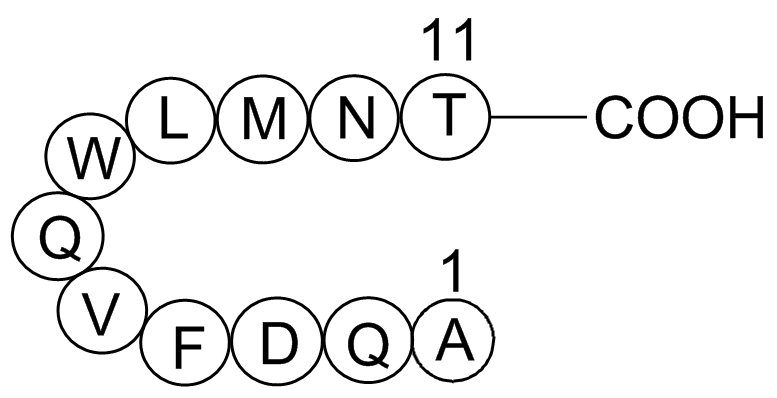

Glucagon (19-29), human [64790-15-4]

Cat# A1019-5mg
Size : 5mg
Brand : APExBIO Technology
Contact local distributor :
 Phone : +1 850 650 7790
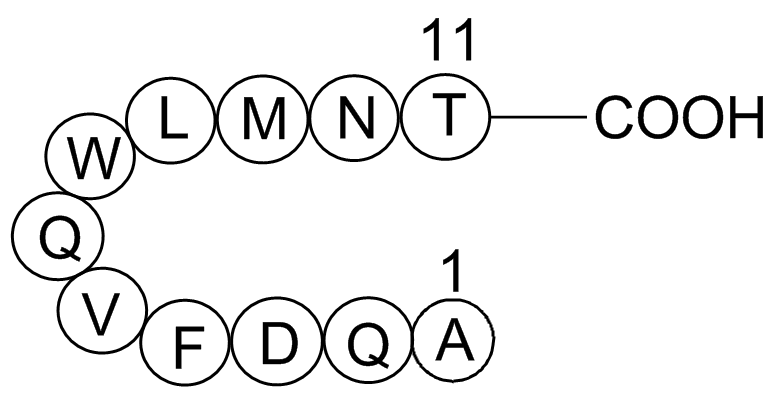
Glucagon(NH2-His-Ser-Gln-Gly-Thr-Phe-Thr-Ser-Asp-Tyr-Ser-Lys-Tyr-Leu-Asp-Ser-Arg-Arg-Ala-Gln-Asp-Phe-Val-Gln-Trp-Leu-Met-Asn-Thr-COOH) is a peptide hormone, secreted by the pancreas, that raises blood glucose levels. Glucagon’s effect is opposite that of insulin, which lowers blood glucose levels. Miniglucagon (Glucagon 19–29) is a potent and efficient inhibitor of secretagogue-induced insulin release through a Ca2+ Pathway*. Miniglucagon is a novel local regulator of the pancreatic islet physiology. Any abnormal inhibitory tone exerted by this peptide on the β-cell results in impaired insulin secretion, as observed in type 2 diabetes. Miniglucagon is a component of the positive inotropic effect of glucagon. Some evidence has shown that glucagon processing into miniglucagon may be essential for the positive inotropic effect of glucagon on heart contraction.
Ref:
1. Reece J, Campbell N (2002). Biology. San Francisco: Benjamin Cummings. ISBN 0-8053-6624-5.
2. Stéphane Dalle, Ghislaine Fontés, Anne-Dominique Lajoix2, Laurence LeBrigand, René Gross, Gérard Ribes, Michel Dufour, Léo Barry, Dung LeNguyen and Dominique Bataille, Miniglucagon (Glucagon 19-29) A Novel Regulator of the Pancreatic Islet Physiology, doi:10.2337/diabetes.51.2.406Diabetes February 2002 vol. 51 no. 2406-412
3. Pavoine C, Brechler V, Kervan A, Blache Kervan, Le-Nguyen D, Laurent S, Bataille D, Pecker F (1991) Miniglucagon [glucagon-(19-29)] is a component of the positive inotropic effect of glucagon. Am J Physiol 260:C993–C999.
| Physical Appearance | A solid |
| Storage | Store at -20°C |
| M.Wt | 1352.51 |
| Cas No. | 64790-15-4 |
| Formula | C61H89N15O18S |
| Synonyms | H2N-Ala-Gln-Asp-Phe-Val-Gln-Trp-Leu-Met-Asn-Thr-OH |
| Solubility | insoluble in EtOH; insoluble in H2O; ≥135.2 mg/mL in DMSO |
| Chemical Name | Glucagon (19-29), human |
| Canonical SMILES | CC(C)CC(C(=O)NC(CCSC)C(=O)NC(CC(=O)N)C(=O)NC(C(C)O)C(=O)O)NC(=O)C(CC1=CNC2=CC=CC=C21)NC(=O)C(CCC(=O)N)NC(=O)C(C(C)C)NC(=O)C(CC3=CC=CC=C3)NC(=O)C(CC(=O)O)NC(=O)C(CCC(=O)N)NC(=O)C(C)N |
| Shipping Condition | Small Molecules with Blue Ice, Modified Nucleotides with Dry Ice. |
| General tips | We do not recommend long-term storage for the solution, please use it up soon. |
| Cell experiment:[1] | |
| Cell lines | MIN6 cells |
| Reaction Conditions | 0.01 ~ 1000 pM miniglucagon for 2 h incubation |
| Applications | Miniglucagon dose-dependently (ID50 = 1 pM) inhibited by 80 ~ 100% the insulin release triggered by glucose, glucagon, glucagon-like peptide-1-(7-36) amide (tGLP-1), or glibenclamide. Miniglucagon, at the doses active on insulin release, was able to block the increase in 45Ca2+ uptake induced by depolarizing agents (glucose or extracellular K+), glucagon, or the Ca2+ channel agonist Bay K-8644. In addition, pretreatment with pertussis toxin abolished the effects of miniglucagon on insulin release. These data suggest that miniglucagon is a highly potent and efficient inhibitor of insulin release by closing, via hyperpolarization, voltage-dependent Ca2+ channels linked to a pathway involving a pertussis toxin-sensitive G protein. |
| Note | The technical data provided above is for reference only. |
| References: 1. Dalle S, Smith P, Blache P, et al. Miniglucagon (glucagon 19-29), a potent and efficient inhibitor of secretagogue-induced insulin release through a Ca2+ pathway. Journal of Biological Chemistry, 1999, 274(16): 10869-10876. | |
Quality Control & MSDS
- View current batch:
Chemical structure