
DNMT1 Recombinant Protein

Cat# OPCD02777-50UG
Size : 50ug
Brand : Aviva Systems Biology
Contact local distributor :

Phone : +1 850 650 7790
DNMT1 Recombinant Protein (OPCD02777)
| Datasheets/Manuals | Printable datasheet for DNMT1 Recombinant Protein (OPCD02777) |
|---|
| Predicted Species Reactivity | Homo sapiens|Human |
|---|---|
| Product Format | Freeze-dried Powder. PBS, pH7.4, containing 0.01% SKL, 5% Trehalose. |
| Host | E.coli |
| Conjugation | Unconjugated |
| Application | Ctrl (+), SDS-PAGE, WB |
| Additional Information | Endotoxin Level: < 1.0 EU per 1 ug (determined by the LAL method) |
| :: | Residues: Val1343-Leu1570 |
| :: | Subcellular Location: Nucleus |
| Reconstitution and Storage | 2°C to 8°C|-80°C |
| Concentration | 200 ug/mL (prior to lyoph) |
| Purity | > 95% |
| Source | E.coli |
| Tag | N-terminal His Tag |
| Gene Symbol | DNMT1 |
|---|---|
| Gene Full Name | DNA methyltransferase 1 |
| Alias Symbols | ADCADN;AIM;CXXC9;CXXC-type zinc finger protein 9;DNA (cytosine-5)-methyltransferase 1;DNA (cytosine-5-)-methyltransferase 1;DNA methyltransferase HsaI;DNA MTase HsaI;DNMT;HSN1E;m.HsaI;MCMT. |
| NCBI Gene Id | 1786 |
| Protein Name | DNA (cytosine-5)-methyltransferase 1 |
| Description of Target | Methylates CpG residues. Preferentially methylates hemimethylated DNA. Associates with DNA replication sites in S phase maintaining the methylation pattern in the newly synthesized strand, that is essential for epigenetic inheritance. Associates with chromatin during G2 and M phases to maintain DNA methylation independently of replication. It is responsible for maintaining methylation patterns established in development. DNA methylation is coordinated with methylation of histones. Mediates transcriptional repression by direct binding to HDAC2. In association with DNMT3B and via the recruitment of CTCFL/BORIS, involved in activation of BAG1 gene expression by modulating dimethylation of promoter histone H3 at H3K4 and H3K9. Probably forms a corepressor complex required for activated KRAS-mediated promoter hypermethylation and transcriptional silencing of tumor suppressor genes (TSGs) or other tumor-related genes in colorectal cancer (CRC) cells (PubMed:24623306). Also required to maintain a transcriptionally repressive state of genes in undifferentiated embryonic stem cells (ESCs) (PubMed:24623306). Associates at promoter regions of tumor suppressor genes (TSGs) leading to their gene silencing (PubMed:24623306). Promotes tumor growth (PubMed:24623306). |
| Uniprot ID | P26358 |
| Protein Accession # | NP_001124295.1 |
| Nucleotide Accession # | NM_001130823.2 |
| Protein Size (# AA) | Val1343~Leu1570 |
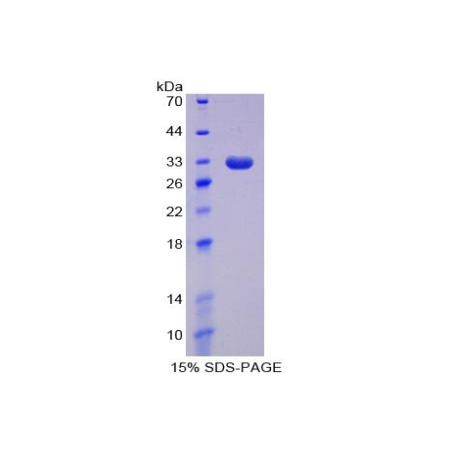
| Molecular Weight | 32kDa |