

Quimigen Portugal > DDX3X Antibody - C-terminal region
DDX3X Antibody - C-terminal region

Cat# OAAB01241
Size : 400µl
Contact local distributor :

Phone : +1 850 650 7790
Brand : Aviva Systems Biology
Contact local distributor :
Phone : +1 850 650 7790
DDX3X Antibody - C-terminal region (OAAB01241)
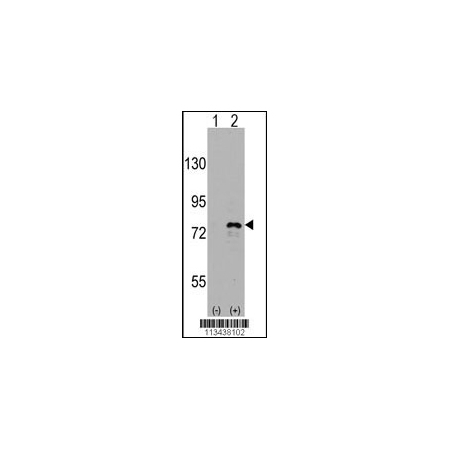
| Datasheets/Manuals | Printable datasheet for DDX3X Antibody - C-terminal region (OAAB01241) |
|---|
| Publications | Cell type-dependent suppression of the RNA helicase DDX3Y levels by the close paralog DDX3X Authors: Xu, X., Rainey, J., et al. Journal: Front Cell Dev Biol. 14, 1644807 (2026) Diverse mechanisms of DDX3Y suppression by DDX3X Authors: Xu, X., Wei, S., et al. Journal: bioRxiv. (2025) Preprint — no PubMed record available |
|---|---|
| Tested Species Reactivity | Human |
| Predicted Species Reactivity | Human|Mouse|Xenopus |
| Product Format | Liquid. PBS with 0.09% (W/V) sodium azide |
| Clonality | Polyclonal |
| Isotype | Ig |
| Host | Rabbit |
| Application | IHC-P,WB |
| Additional Information | Cellular Location: Nucleus speckle. Cytoplasm. Mitochondrion outer membrane. Note=Located predominantly in nuclear speckles and, at low levels, throughout the cytoplasm. Located to the outer side of nuclear pore complexes (NPC). Shuttles between the nucleus and the cytoplasm in a XPO1 and may be also in a NFX1-dependent manner. Associated with polyadenylated mRNAs in the cytoplasm and the nucleus. Predominantly located in nucleus during G(0) phase and in the cytoplasm during G1/S phase. |
| Reconstitution and Storage | Maintain refrigerated at 2-8°C for up to 2 weeks. For long term storage store at -20°C in small aliquots to prevent freeze-thaw cycles. |
| Immunogen | This DDX3 antibody is generated from rabbits immunized with a KLH conjugated synthetic peptide between 456-485 amino acids from the C-terminal region of human DDX3. |
| Purification | This antibody is purified by Saturated Ammonium Sulfate (SAS) precipitation followed by dialysis against PBS. |
| Predicted Homology Based on Immunogen Sequence | Mouse, Xenopus |
| Concentration | Varies by lot. See vial for concentration. |
| Intended Use | For research use only and not for use in diagnostic or therapeutic procedures. |
| Application Info | WB: 1:1000 IHC-P: 1:10~50 |
| Gene Symbol | DDX3X |
|---|---|
| Gene Full Name | DEAD-box helicase 3 X-linked |
| Alias Symbols | ATP-dependent RNA helicase DDX3X, ATP-dependent RNA helicase DDX3Y, CAP-Rf, D-E-A-D (aspartate-glutamate-alanine-aspartate) box polypeptide 3, D1Pas, D1Pas1-related sequence 2, D1Pas1-rs2, DBX, DBY, DDX14, DDX3, DEAD (Asp-Glu-Ala-Asp) box helicase 3, X-linked, DEAD (Asp-Glu-Ala-Asp) box helicase 3, Y-linked, DEAD (Asp-Glu-Ala-Asp) box polypeptide 3, X-linked, DEAD (Asp-Glu-Ala-Asp) box polypeptide 3, Y-linked, DEAD (aspartate-glutamate-alanine-aspartate) box polypeptide 3, DEAD box protein 3, X-chromosomal, DEAD box protein 3, Y-chromosomal, DEAD box RNA helicase DEAD3, DEAD box, X isoform, DEAD-box protein 3 (DEAD-box RNA helicase DEAD3) (mDEAD3) (Embryonic RNA helicase) (D1PAS1 related sequence 2), DEAD/H (Asp-Glu-Ala-Asp/His) box polypeptide 3, DEAD/H (Asp-Glu-Ala-Asp/His) box polypeptide 3, X-linked, DEAD/H (Asp-Glu-Ala-Asp/His) box polypeptide, Y chromosome, DEAD/H box-3, embryonic RNA helicase, fibroblast growth factor inducible 14, Fin, Fin14, helicase-like protein 2, HLP2, mDEAD3, MRX102, MRXSSB, Pl, Pl10, putative ATP-dependent RNA helicase Pl10. |
| NCBI Gene Id | 110957|13205|1654|8653 |
| Protein Name | ATP-dependent RNA helicase DDX3X|ATP-dependent RNA helicase DDX3X isoform 1 [Homo sapiens]|ATP-dependent RNA helicase DDX3X isoform 3 [Homo sapiens]|ATP-dependent RNA helicase DDX3Y|Putative ATP-dependent RNA helicase an3|Putative ATP-dependent RNA helicase Pl10 |
| Description of Target | Multifunctional ATP-dependent RNA helicase. The ATPase activity can be stimulated by various ribo- and deoxynucleic acids indicative for a relaxed substrate specificity. In vitro can unwind partially double-stranded DNA with a preference for 5'-single-stranded DNA overhangs. Is involved in several steps of gene expression, such as transcription, mRNA maturation, mRNA export and translation. However, the exact mechanisms are not known and some functions may be specific for a subset of mRNAs. Involved in transcriptional regulation. Can enhance transcription from the CDKN1A/WAF1 promoter in a SP1-dependent manner. Found associated with the E-cadherin promoter and can down-regulate transcription from the promoter. Involved in regulation of translation initiation. Proposed to be involved in positive regulation of translation such as of cyclin E1/CCNE1 mRNA and specifically of mRNAs containing complex secondary structures in their 5'UTRs; these functions seem to require RNA helicase activity. Specifically promotes translation of a subset of viral and cellular mRNAs carrying a 5'proximal stem-loop structure in their 5'UTRs and cooperates with the eIF4F complex. Proposed to act prior to 43S ribosomal scanning and to locally destabilize these RNA structures to allow recognition of the mRNA cap or loading onto the 40S subunit. After association with 40S ribosomal subunits seems to be involved in the functional assembly of 80S ribosomes; the function seems to cover translation of mRNAs with structured and non-structured 5'UTRs and is independent of RNA helicase activity. Also proposed to inhibit cap-dependent translation by competetive interaction with EIF4E which can block the EIF4E:EIF4G complex formation. Proposed to be involved in stress response and stress granule assembly; the function is independent of RNA helicase activity and seems to involve association with EIF4E. May be involved in nuclear export of specific mRNAs but not in bulk mRNA export via interactions with XPO1 and NXF1. Also associates with polyadenylated mRNAs independently of NXF1. Associates with spliced mRNAs in an exon junction complex (EJC)-dependent manner and seems not to be directly involved in splicing. May be involved in nuclear mRNA export by association with DDX5 and regulating its nuclear location. Involved in innate immune signaling promoting the production of type I interferon (IFN-alpha and IFN-beta); proposed to act as viral RNA sensor, signaling intermediate and transcriptional coactivator. Involved in TBK1 and IKBKE-dependent IRF3 activation leading to IFNB induction, plays a role of scaffolding adapter that links IKBKE and IRF3 and coordinates their activation. Also found associated with IFNB promoters; the function is independent of IRF3. Can bind to viral RNAs and via association with MAVS/IPS1 and DDX58/RIG-I is thought to induce signaling in early stages of infection. Involved in regulation of apoptosis. May be required for activation of the intrinsic but inhibit activation of the extrinsic apoptotic pathway. Acts as an antiapoptotic protein through association with GSK3A/B and BIRC2 in an apoptosis antagonizing signaling complex; activation of death receptors promotes caspase-dependent cleavage of BIRC2 and DDX3X and relieves the inhibition. May be involved in mitotic chromosome segregation. Is an allosteric activator of CSNK1E, it stimulates CSNK1E-mediated phosphorylation of DVL2 and is involved in the positive regulation of canonical Wnt signaling (By similarity).|Multifunctional ATP-dependent RNA helicase. The ATPase activity can be stimulated by various ribo- and deoxynucleic acids indicative for a relaxed substrate specificity. In vitro can unwind partially double-stranded DNA with a preference for 5'-single-stranded DNA overhangs. Is involved in several steps of gene expression, such as transcription, mRNA maturation, mRNA export and translation. However, the exact mechanisms are not known and some functions may be specific for a subset of mRNAs. Involved in transcriptional regulation. Can enhance transcription from the CDKN1A/WAF1 promoter in a SP1-dependent manner. Found associated with the E-cadherin promoter and can down-regulate transcription from the promoter. Involved in regulation of translation initiation. Proposed to be involved in positive regulation of translation such as of cyclin E1/CCNE1 mRNA and specifically of mRNAs containing complex secondary structures in their 5'UTRs; these functions seem to require RNA helicase activity. Specifically promotes translation of a subset of viral and cellular mRNAs carrying a 5'proximal stem-loop structure in their 5'UTRs and cooperates with the eIF4F complex. Proposed to act prior to 43S ribosomal scanning and to locally destabilize these RNA structures to allow recognition of the mRNA cap or loading onto the 40S subunit. After association with 40S ribosomal subunits seems to be involved in the functional assembly of 80S ribosomes; the function seems to cover translation of mRNAs with structured and non-structured 5'UTRs and is independent of RNA helicase activity. Also proposed to inhibit cap-dependent translation by competetive interaction with EIF4E which can block the EIF4E:EIF4G complex formation. Proposed to be involved in stress response and stress granule assembly; the function is independent of RNA helicase activity and seems to involve association with EIF4E. May be involved in nuclear export of specific mRNAs but not in bulk mRNA export via interactions with XPO1 and NXF1. Also associates with polyadenylated mRNAs independently of NXF1. Associates with spliced mRNAs in an exon junction complex (EJC)-dependent manner and seems not to be directly involved in splicing. May be involved in nuclear mRNA export by association with DDX5 and regulating its nuclear location. Involved in innate immune signaling promoting the production of type I interferon (IFN-alpha and IFN-beta); proposed to act as viral RNA sensor, signaling intermediate and transcriptional coactivator. Involved in TBK1 and IKBKE-dependent IRF3 activation leading to IFNB induction, plays a role of scaffolding adapter that links IKBKE and IRF3 and coordinates their activation. Also found associated with IFNB promoters; the function is independent of IRF3. Can bind to viral RNAs and via association with MAVS/IPS1 and DDX58/RIG-I is thought to induce signaling in early stages of infection. Involved in regulation of apoptosis. May be required for activation of the intrinsic but inhibit activation of the extrinsic apoptotic pathway. Acts as an antiapoptotic protein through association with GSK3A/B and BIRC2 in an apoptosis antagonizing signaling complex; activation of death receptors promotes caspase-dependent cleavage of BIRC2 and DDX3X and relieves the inhibition. May be involved in mitotic chromosome segregation. Is an allosteric activator of CSNK1E, it stimulates CSNK1E-mediated phosphorylation of DVL2 and is involved in the positive regulation of canonical Wnt signaling (PubMed:23413191).|Probable ATP-dependent RNA helicase. May play a role in spermatogenesis.|Putative ATP-dependent RNA helicase. Possible role in a key step of the spermatogenic process.|Putative ATP-dependent RNA helicase. Required for Wnt signaling involved in anteroposterior neural patterning (PubMed:23413191). |
| Uniprot ID | O00571|O15523|P16381|P24346|Q62167 |
| Protein Accession # | https://www.ncbi.nlm.nih.gov/protein/NP_001180346.1,NP_001347.3 |
| Molecular Weight | 73 kDa |
Protein interactions
| Name | # of Products |
|---|---|
| APBB1 | 142 |
| C20orf24 | 33 |
| CD4 | 497 |
| CD40 | 87 |
| DYNLL1 | 243 |
| EIF4A2 | 59 |
| ELF3 | 34 |
| ESR1 | 695 |
| HCVgp1 | 103 |
| HDAC5 | 906 |
| ILK | 145 |
| Mapk13 | 300 |
| NEDD4 | 260 |
| NFKB2 | 77 |
| NUP62 | 63 |
| PCK1 | 184 |
| PIN1 | 256 |
| POT1 | 102 |
| PUF60 | 88 |
| SAP18 | 48 |
| SREK1 | 122 |
| SRRM2 | 277 |
| SUMO2 | 442 |
| TADA2A | 195 |
| Tat | 632 |
| TERF2 | 313 |
| TRAF6 | 443 |
| UBC | 7030 |
| VHL | 414 |
| WBP4 | 96 |
| XPO1 | 191 |
| YWHAQ | 716 |
Biological pathways
| Name | # of Products |
|---|---|
| Interspecies interaction between organisms | 817 |
Biological process
| Name | # of Products |
|---|---|
| Interspecies interaction between organisms | 281 |
Cellular components
| Name | # of Products |
|---|---|
| Cytoplasm | 4549 |
| Nuclear speck | 110 |
| Nucleus | 4914 |
Protein function
| Name | # of Products |
|---|---|
| ATP binding | 2814 |
| ATP-dependent RNA helicase activity | 33 |
| DNA binding | 3958 |
| Helicase activity | 219 |
| Hydrolase activity | 1739 |
| Nucleotide binding | 3928 |
| RNA binding | 1153 |
-
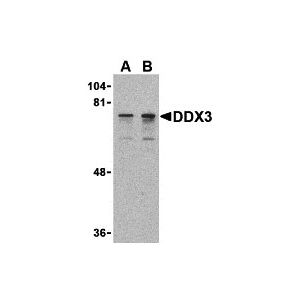 DDX3X Antibody (OAPB00391)Catalog #: OAPB00391Conjugation: UnconjugatedApplication: ELISA, ICC, IF, WBFormat: Liquid. DDX3 Antibody is supplied in PBS containing 0.02% sodium azide.
-
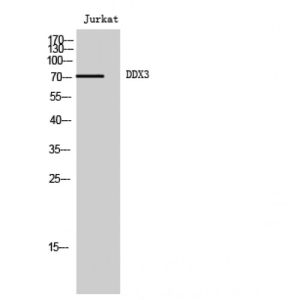 DDX3X Antibody (OASG02116)Catalog #: OASG02116Application: ELISA, WBFormat: Liquid. 1 mg/mL in PBS containing 50% glycerol, 0.5% BSA and 0.02% sodium azide.
-
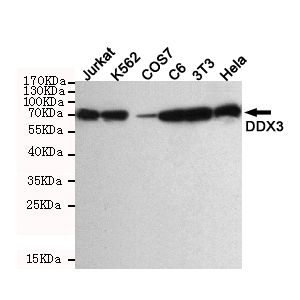
-
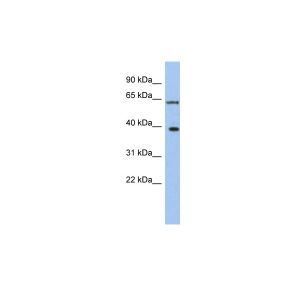 DDX3X Antibody - N-terminal region (ARP36342_P050)Catalog #: ARP36342_P050Species Tested: Human, MouseApplication: IHC, WBFormat: Liquid. Purified antibody supplied in 1x PBS buffer with 0.09% (w/v) sodium azide and 2% sucrose.