
AMACR Antibody - middle region - HRP

Cat# ARP60807_P050-HRP
Size : 100ul
Brand : Aviva Systems Biology
Contact local distributor :
 Phone : +1 850 650 7790
AMACR Antibody - middle region : HRP (ARP60807_P050-HRP)

| Datasheets/Manuals | Printable datasheet for anti-AMACR (ARP60807_P050-HRP) antibody |
|---|
| Predicted Species Reactivity | Human, Rat, Cow, Dog, Horse, Pig, Rabbit |
|---|---|
| Product Format | Liquid. Purified antibody is supplied in high phosphate PBS, 100 mm phosphate, 150 mM NaCl, pH 7.6. |
| Clonality | Polyclonal |
| Host | Rabbit |
| Conjugation | HRP: Horseradish Peroxidase |
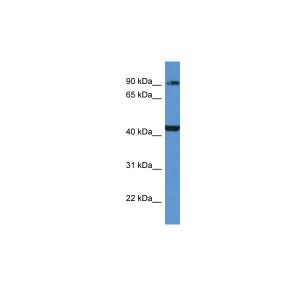
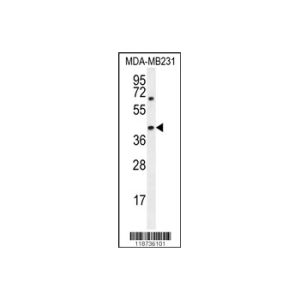
| Application | WB |
| Reconstitution and Storage | All conjugated antibodies should be stored in light-protected vials or covered with a light protecting material (i.e. aluminum foil). Conjugated antibodies are stable for at least 12 months at 4C. If longer storage is desired (24 months), conjugates may be diluted with up to 50% glycerol and stored at -20C to -80C. Freezing and thawing conjugated antibodies will compromise enzyme activity as well as antibody binding. |
| Purification | Affinity Purified |
| Predicted Homology Based on Immunogen Sequence | Cow: 86%; Dog: 85%; Horse: 85%; Human: 100%; Pig: 85%; Rabbit: 79%; Rat: 91% |
| Peptide Sequence | Synthetic peptide located within the following region: SGENPYAPLNLLADFAGGGLMCALGIIMALFDRTRTGKGQVIDANMVEGT |
| Concentration | 0.5 mg/ml |
| Blocking Peptide | For anti-AMACR (ARP60807_P050-HRP) antibody is Catalog # AAP60807 |
| Sample Type Confirmation | AMACR is strongly supported by BioGPS gene expression data to be expressed in 721_B |
| Gene Symbol | AMACR |
|---|---|
| Gene Full Name | Alpha-methylacyl-CoA racemase |
| Alias Symbols | RM, RACE, CBAS4, P504S, AMACRD |
| NCBI Gene Id | 23600 |
| Protein Name | Alpha-methylacyl-CoA racemase Ensembl ENSP00000371517 |
| Description of Target | This gene encodes a racemase. The encoded enzyme interconverts pristanoyl-CoA and C27-bile acylCoAs between their (R)- and (S)-stereoisomers. The conversion to the (S)-stereoisomers is necessary for degradation of these substrates by peroxisomal beta-oxidation. Encoded proteins from this locus localize to both mitochondria and peroxisomes. Mutations in this gene may be associated with adult-onset sensorimotor neuropathy, pigmentary retinopathy, and adrenomyeloneuropathy due to defects in bile acid synthesis. Alternatively spliced transcript variants have been described. Read-through transcription also exists between this gene and the upstream neighboring C1QTNF3 (C1q and tumor necrosis factor related protein 3) gene. |
| Uniprot ID | F8W9N1 |
| Protein Accession # | NP_001161067 |
| Nucleotide Accession # | NM_001167595 |
| Protein Size (# AA) | 394 |
| Molecular Weight | 43kDa |
| Protein Interactions | UBC; PEX5; |