

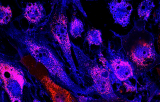
FISH probes - Molecular cytogenetics - Di Georges or velocardiofacial syndrome (VCFS)
The 22q11.2 deletion syndrome (22q11.2DS), also known as velocardiofacial syndrome (VCFS) and DiGeorge syndrome, is a genetic disorder caused by hemizygous microdeletions on chromosome 22q11.2, with population prevalence of about 1 in 4,000 births. The characteristic phenotype of 22q11.2DS includes cardiac defects, immune deficiency, growth restriction, and deficits in cognitive abilities. The 22q11.2 deletion usually occurs by meiotic non-allelic homologous recombination events between low copy repeats on chromosome 22q11.2 termed LCR22. There are eight LCR22s that span the 22q11.2 region termed LCR22A through LCR22H. The majority (90%) of 22q11.2DS patients show a recurrent 3 Mb deletion between LCR22A and LCR22D while 8% harbor a nested 1.5 Mb deletion (LCR22A-B). Some rare atypical deletions of shorter size and in variable locations have also been reported (e.g., LCR22B-D and LCR22C-D). Classic FISH probes for the detection of 22q11.2DS target the HIRA gene mapping to the LCR22A-B region, and thus, miss deletions that occur outside this region. The DiGeorge Triple Color Probe additionally targets CRKL that maps to the LCR22C-D region allowing the detection of rare deletions.
Resultado da sua pesquisa : 0 produto encontrado
Refine sua procura :
RUO
CE/IVD
NEW
Referência
Descrição
Cond.
Price Bef. VAT
‹
›