
TRPV1 Antibody - C-terminal

Referência OAPB01697
Tamanho : 0.1mg
Marca : Aviva Systems Biology
Contactar o distribuidor local :
 Telefone : +1 850 650 7790
TRPV1 Antibody - C-terminal (OAPB01697)
| Datasheets/Manuals | Printable datasheet for TRPV1 Antibody - C-terminal (OAPB01697) (OAPB01697) |
|---|
| Predicted Species Reactivity | Guinea Pig|Human|Mouse |
|---|---|
| Product Format | Liquid. TRPV1 Antibody is supplied in PBS containing 0.02% sodium azide. |
| Clonality | Polyclonal |
| Isotype | IgG |
| Host | Rabbit |
| Conjugation | Unconjugated |
| Application | ELISA, WB |
| Reconstitution and Storage | For short term use, store at 2-8C up to 1 week. For long term storage, store at -20C in small aliquots to prevent freeze-thaw cycles. |
| Immunogen | Rabbit polyclonal TRPV1 antibody was raised against a 16 amino acid peptide near the carboxy terminus of human TRPV1. The immunogen is located within the last 50 amino acids of TRPV1. |
| Purification | Affinity Purified |
| Concentration | 1 mg/ml |
| Gene Symbol | TRPV1 |
|---|---|
| Gene Full Name | transient receptor potential cation channel subfamily V member 1 |
| Alias Symbols | capsaicin receptor;osm-9-like TRP channel 1;OTRPC1;transient receptor potential cation channel subfamily V member 1;transient receptor potential vanilloid 1a;transient receptor potential vanilloid 1b;Vanilloid receptor 1;vanilloid receptor subtype 1;VR1. |
| NCBI Gene Id | 7442 |
| Protein Name | Transient receptor potential cation channel subfamily V member 1|transient receptor potential cation channel subfamily V member 1 [Homo sapiens] |
| Description of Target | Ligand-activated non-selective calcium permeant cation channel involved in detection of noxious chemical and thermal stimuli. Seems to mediate proton influx and may be involved in intracellular acidosis in nociceptive neurons. Involved in mediation of inflammatory pain and hyperalgesia. Sensitized by a phosphatidylinositol second messenger system activated by receptor tyrosine kinases, which involves PKC isozymes and PCL. Activation by vanilloids, like capsaicin, and temperatures higher than 42 degrees Celsius, exhibits a time- and Ca(2+)-dependent outward rectification, followed by a long-lasting refractory state. Mild extracellular acidic pH (6.5) potentiates channel activation by noxious heat and vanilloids, whereas acidic conditions (pH <6) directly activate the channel. Can be activated by endogenous compounds, including 12-hydroperoxytetraenoic acid and bradykinin. Acts as ionotropic endocannabinoid receptor with central neuromodulatory effects. Triggers a form of long-term depression (TRPV1-LTD) mediated by the endocannabinoid anandamine in the hippocampus and nucleus accumbens by affecting AMPA receptors endocytosis. |
| Uniprot ID | Q8NER1 |
| Protein Accession # | https://www.ncbi.nlm.nih.gov/protein/NP_542437 |
| Nucleotide Accession # | NM_018727.5 |
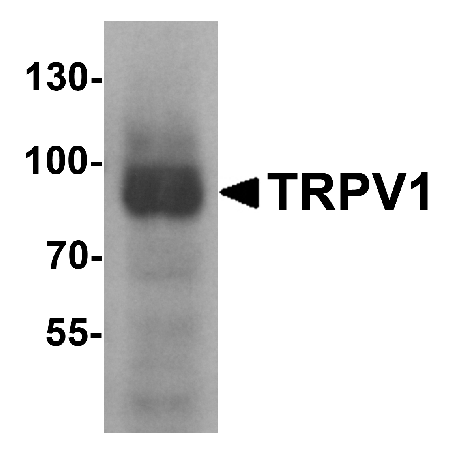
| Molecular Weight | Predicted: 92 kDa |