

SARS-CoV-2 Spike RBD Nanobody

Referência CSB-RA33245A2GMY-100ul
Tamanho : 100ul
Marca : Cusabio
Contactar o distribuidor local :

Telefone : +1 850 650 7790
| Image |
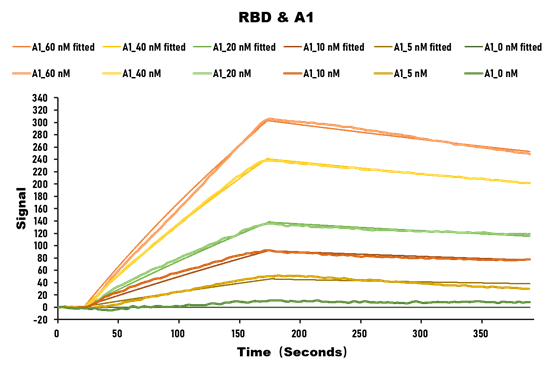
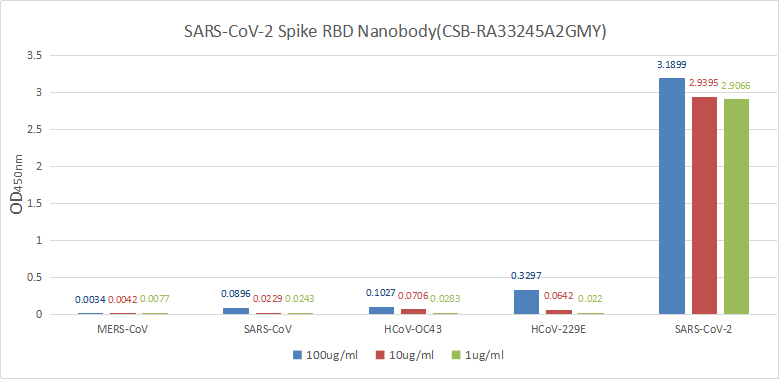
Product Details
Uniprot No.
Target Names
S (Spike glycoprotein)
Alternative Names
S; 2; Spike glycoprotein; S glycoprotein; E2; Peplomer protein)
Species Reactivity
Human Novel Coronavirus (SARS-CoV-2/ 2019-nCoV)
Immunogen
Recombinant Human Novel Coronavirus Spike glycoprotein(S) (319-541aa) ( and )
Immunogen Species
Human Novel Coronavirus (SARS-CoV-2/ 2019-nCoV)
Conjugate
Non-conjugated
Clonality
Monoclonal
Isotype
VHH fusion with human IgG1 Fc
Clone No.
A1
Purification Method
Affinity-chromatography
Concentration
It differs from different batches. Please contact us to confirm it.
Buffer
Preservative: 0.03% Proclin 300
Constituents: 50% Glycerol, 0.01M PBS, pH 7.4
Constituents: 50% Glycerol, 0.01M PBS, pH 7.4
Form
Liquid
Tested Applications
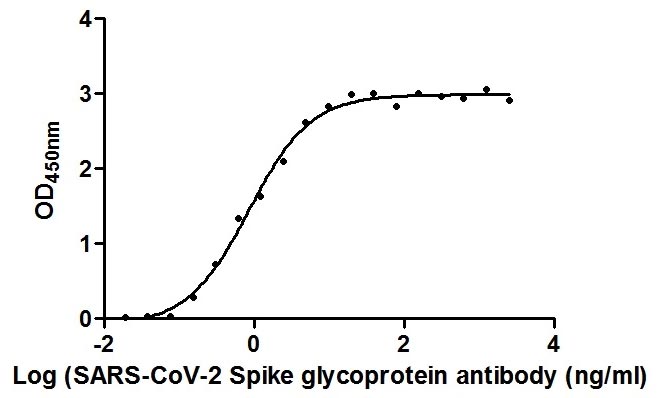
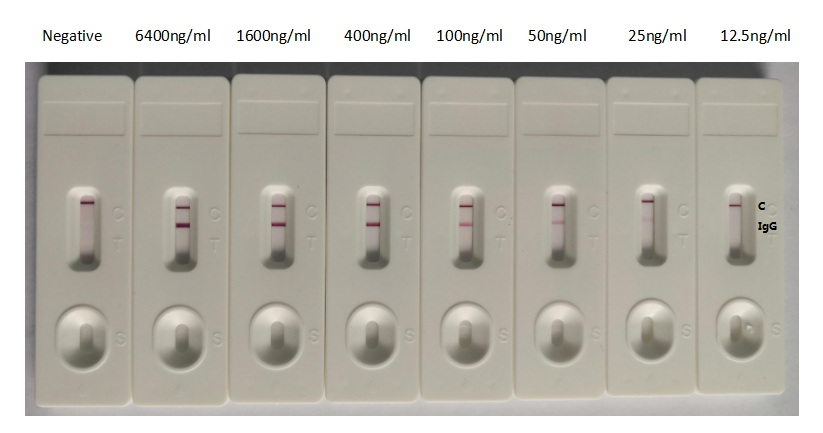
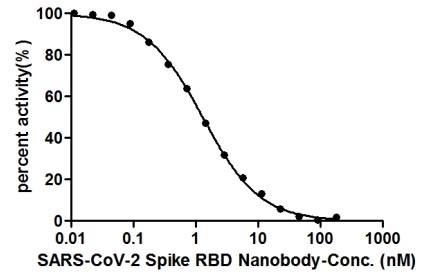
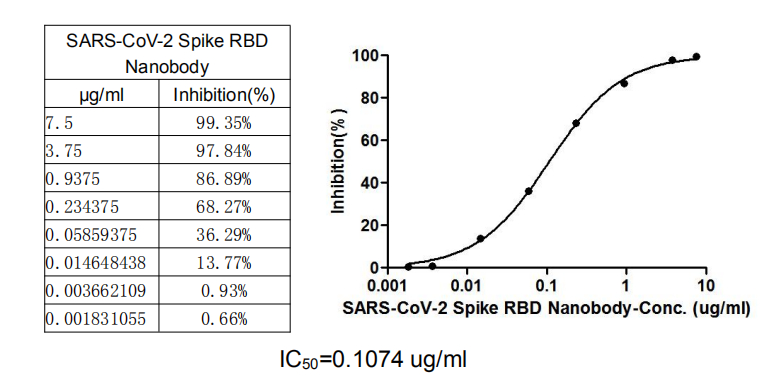
ELISA, GICA, Neutralising
Recommended Dilution
| Application | Recommended Dilution |
|---|---|
| ELISA | 1:10000-1:100000 |
| GICA | 1:10000-1:40000 |
| Neutralising | 1:100-1:10000 |
Protocols
FAQs
Storage
Upon receipt, store at -20°C or -80°C. Avoid repeated freeze.
Description
The SARS-CoV-2 spike glycoprotein receptor-binding domain represents a critical interface in viral pathogenesis, mediating the initial attachment to human ACE2 receptors that enables cellular entry. This interaction has made the RBD a focal point for therapeutic development, diagnostic assay design, and fundamental studies of coronavirus biology. This recombinant nanobody, derived from alpaca VHH sequences fused to a human IgG1 Fc domain, offers researchers a uniquely compact binding format with exceptional affinity. The recombinant production method ensures sequence-defined consistency...
Usage
For Research Use Only. Not for use in diagnostic or therapeutic procedures.
Customer Reviews and Q&A
There are currently no reviews for this product.
■ Q&A
Q:
Where was CSB-RA33245A2GMY purified from? cell culture / hybridoma or serum / ascites?
A:
It is a Nanobody that expressed from 293 cells (HEK293).
Q:
What is the concentration of this antibody, do you have this antibody in stock?
A:
The concentration of CSB-RA33245A2GMY is 1mg/ml, we have stock for this antibody and the lead time is 1-2 working days.
Q:
I am interested in this product. What is the detection limit? Is it below 100-1000 SARS-CoV-2 particles?
A:
We do not have information on the exact number of SARS-CoV-2 particles detected by the SARS-CoV-2 Spike RBD Nanobody. Please refer to the attached data sheet for the detection limit.
Q:
Is there any advantage of Nanobody compared with traditional hybridoma monoclonal antibody?
A:
Compared with traditional hybridoma monoclonal antibody, the Nanobody has many advantages as below.
1. The homology between sequences of VH and VHH is very high, so the Nanobody can be humanized easily.
2. The Nanobodies are more likely to bind with antigens specifically, so the Nanobodies have a high affinity.
3. The Nanobodies are very stable on quality, because they can...
1. The homology between sequences of VH and VHH is very high, so the Nanobody can be humanized easily.
2. The Nanobodies are more likely to bind with antigens specifically, so the Nanobodies have a high affinity.
3. The Nanobodies are very stable on quality, because they can...
Q:
What's the meaning of "Nanobody"?
A:
The antibody contains only one heavy-chain variable region (VHH) and two regular CH2 and CH3 regions, but it does not stick to each other or even clump together as easily as the artificially engineered single-chain antibody fragment (scFv). More importantly, the independently cloned and expressed VHH structure has the same structural stability as the original heavy chain...
Target Background
Function
attaches the virion to the cell membrane by interacting with host receptor, initiating the infection. Binding to human ACE2 receptor and internalization of the virus into the endosomes of the host cell induces conformational changes in the Spike glycoprotein. Binding to host NRP1 and NRP2 via C-terminal polybasic sequence enhances virion entry into host cell. This interaction may explain virus tropism of human olfactory epithelium cells, which express high level of NRP1 and NRP2 but low level of ACE2. The stalk domain of S contains three hinges, giving the head unexpected orientational...
Gene References into Functions
- Study presents crystal structure of C-terminal domain of SARS-CoV-2 (SARS-CoV-2-CTD) spike S protein in complex with human ACE2 (hACE2); hACE2-binding mode similar overall to that observed for SARS-CoV. However, details at the binding interface show that key residue substitutions in SARS-CoV-2-CTD slightly strengthen the interaction and lead to higher affinity for receptor binding than SARS-CoV receptor-binding domain.
- crystal structure of the receptor-binding domain (RBD) of the spike protein of SARS-CoV-2 bound to the cell receptor ACE2
- crystal structure of the receptor-binding domain (RBD) of the spike protein of SARS-CoV-2 (engineered to facilitate crystallization) in complex with ACE2
- Out of the two isolates from India compared to the isolates from Wuhan, China, one was found to harbor a mutation in its receptor-binding domain (RBD) at position 407 where, arginine was replaced by isoleucine. This mutation has been seen to change the secondary structure of the protein at that region and this can potentially alter receptor binding of the virus.
- Structural modeling of the SARS-CoV-2 spike glycoprotein show similar receptor utilization between SARS-CoV-2 and SARS-CoV, despite a relatively low amino acid similarity in the receptor binding module. Compared to SARS-CoV and all other coronaviruses in Betacoronavirus lineage B, an extended structural loop containing basic amino acids were identified at the interface of the receptor binding (S1) and fusion (S2) domains.
- crystal structure of CR3022, a neutralizing antibody from a SARS patient, in complex with the receptor-binding domain of the SARS-CoV-2 spike (S) protein to 3.1 A; study provides insight into how SARS-CoV-2 can be targeted by the humoral immune response and revealed a conserved, but cryptic epitope shared between SARS-CoV-2 and SARS-CoV
- SARS-CoV and SARS-CoV-2 spike proteins have comparable binding affinities achieved by balancing energetics and dynamics. The SARS-CoV-2-ACE2 complex contains a higher number of contacts, a larger interface area, and decreased interface residue fluctuations relative to the SARS-CoV-ACE2 complex.
- Interaction interface between cat/dog/pangolin/Chinese hamster ACE2 and SARS-CoV/SARS-CoV-2 S protein was simulated through homology modeling. Authors identified that N82 of ACE2 showed closer contact with receptor-binding domain of S protein than human ACE2.
- SARS-CoV-2 S glycoprotein harbors a furin cleavage site at the boundary between the S1/S2 subunits, which is processed during biogenesis and sets this virus apart from SARS-CoV and SARS-related CoVs; determined cryo-EM structures of the SARS-CoV-2 S ectodomain trimer.
- Study demonstrates that SARS-CoV-2 uses the SARS-CoV receptor ACE2 for entry and the serine protease TMPRSS2 for S protein priming.
- The ACE2-B0AT1 complex exists as a dimer of heterodimers. Structural alignment of the RBD-ACE2-B0AT1 ternary complex with the S protein of SARS-CoV-2 suggests that two S protein trimers can simultaneously bind to an ACE2 homodimer.
- study demonstrated SARS-CoV-2 S protein entry on 293/hACE2 cells is mainly mediated through endocytosis, and PIKfyve, TPC2 and cathepsin L are critical for virus entry; found that SARS-CoV-2 S protein could trigger syncytia in 293/hACE2 cells independent of exogenous protease; there was limited cross-neutralization activity between convalescent sera from SARS and COVID-19 patients
- study determined a 3.5-angstrom-resolution cryo-electron microscopy structure of the 2019-nCoV S trimer in the prefusion conformation; provided biophysical and structural evidence that the 2019-nCoV S protein binds angiotensin-converting enzyme 2 (ACE2) with higher affinity than does severe acute respiratory syndrome (SARS)-CoV S
Subcellular Location
Virion membrane; Single-pass type I membrane protein. Host endoplasmic reticulum-Golgi intermediate compartment membrane; Single-pass type I membrane protein. Host cell membrane; Single-pass type I membrane protein.
Protein Families
Betacoronaviruses spike protein family