

Romidepsin (FK228) [128517-07-7]

Referência M2007-1mg
Tamanho : 1mg
Marca : AbMole Bioscience
Contactar o distribuidor local :
 Telefone : +1 850 650 7790
All AbMole products are for research use only, cannot be used for human consumption.
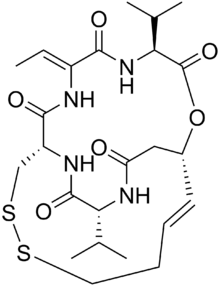
FK228; ISTODAX; Depsipeptide; FR 901228; NSC 630176
Quality Control & Documentation
Biological Activity
Romidepsin (FK228, Depsipeptide, FR 901228, NSC 630176) is a structurally unique, potent HDAC1 and HDAC2 inhibitor with IC50 of 36 nM and 47 nM, respectively. Romidepsin inhibits the growth of U-937, K562, and CCRF-CEM cells with IC50 of 5.92 nM, 8.36 nM, and 6.95 nM, respectively. Romidepsin exhibits concentration-dependent cytotoxicity against a panel of mantle cell lymphoma (MCL) cell lines. FK228 (Romidepsin) treatment potently inhibits the neovascularization of chick embryo and that of adult mice in the Matrigel plug assay. FK228(Romidepsin) is currently in a Phase I study in treating patients with lymphoma, chronic lymphocytic leukemia, or solid tumors with liver dysfunction.*The compound is unstable in solutions, freshly prepared is recommended
Product Citations
-

Cell Death Differ. 2026 Jan 31; .
Targeting the USP7-PRMT6 epigenetic axis overcomes chemoresistance in breast cancer by coordinating H3R2me2a deposition and RNF168 methylation for DNA
Romidepsin (FK228) purchased from AbMole -
Adv Sci (Weinh). 2026 Feb 03;e00194.
Disengaging the Engine: Histone Deacetylases 1 and 2‐Mediated Acetylation of Hexokinase‐2 Regulates Energy Metabolism in Microglia Following Intracerebral
Romidepsin (FK228) purchased from AbMole -
Cancer Res. 2024 May 8.
HDAC Inhibition Increases CXCL12 Secretion to Recruit Natural Killer Cells in Peripheral T Cell Lymphoma | Cancer Research | American Association for Cancer Research
Romidepsin (FK228) purchased from AbMole -
Cell Death Differ. 2023 Mar 9.
Targeting HDAC3 to overcome the resistance to ATRA or arsenic in acute promyelocytic leukemia through ubiquitination and degradation of PML-RARα
Romidepsin (FK228) purchased from AbMole -
Nat Commun. 2019 Dec 20;10(1):5799.
Novel approach reveals genomic landscapes of single-strand DNA breaks with nucleotide resolution in human cells.
Romidepsin (FK228) purchased from AbMole
Protocol (for reference only)
| Cell Experiment | |
|---|---|
| Cell lines | Hut-78 cells, Karpas-299 cells, and normal PBMCs |
| Preparation method | Hut-78 cells, Karpas-299 cells, and normal PBMCs were placed into 96-well plates at a concentration of 5 × 10^4−1 × 10^5 cells/well and incubated in triplicate with increasing concentrations of Romidepsin (0.5–25 nM) and Lenalidomide (1–100 µM) as single agents for 24–72 h to identify the IC50 values of each compound. |
| Concentrations | 0.5–25 nM |
| Incubation time | 24–72 h |
| Animal Experiment | |
|---|---|
| Animal models | Athymic nude mice |
| Formulation | Not mentioned |
| Dosages | 1.2 mg/kg |
| Administration | Injected intraperitoneally |
Chemical Information
| Molecular Weight | 540.7 |
| Formula | C24H36N4O6S2 |
| CAS Number | 128517-07-7 |
| Solubility (25°C) | DMSO 10 mg/mL |
| Storage | Powder -20°C 3 years ; 4°C 2 years In solvent -80°C 6 months ; -20°C 1 month |
References
[1] Coiffier B, et al. J Clin Oncol. Results from a pivotal, open-label, phase II study of romidepsin in relapsed or refractory peripheral T-cell lymphoma after prior systemic therapy.