

Recombinant Pig Prolactin (PRL) - E.coli

Referência CSB-EP018724PI-100ug
Tamanho : 100ug
Marca : Cusabio
Contactar o distribuidor local :

Telefone : +1 850 650 7790
| Abbreviation | Recombinant Pig PRL protein |
| MSDS | |
| Image | |
Product Details
Purity
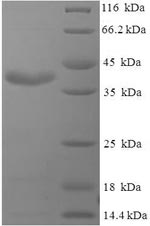
≥ 90% as determined by SDS-PAGE.
Target Names
Uniprot No.
Research Area
Others
Alternative Names
PRL; Prolactin; PRL
Species
Sus scrofa (Pig)
Source
E.coli
Expression Region
31-229aa
Target Protein Sequence
LPICPSGAVNCQVSLRDLFDRAVILSHYIHNLSSEMFNEFDKRYAQGRGFITKAINSCHTSSLSTPEDKEQAQQIHHEVLLNLILRVLRSWNDPLYHLVTEVRGMQEAPDAILSRAIEIEEQNKRLLEGMEKIVGQVHPGIKENEVYSVWSGLPSLQMADEDTRLFAFYNLLHCLRRDSHKIDNYLKLLKCRIIYDSNC
Note: The complete sequence may include tag sequence, target protein sequence, linker sequence and extra sequence that is translated with the protein sequence for the purpose(s) of secretion, stability, solubility, etc.
If the exact amino acid sequence of this recombinant protein is critical to your application, please explicitly request the full and complete sequence of this protein before ordering.
Mol. Weight
39.0kDa
Protein Length
Full Length of Mature Protein
Tag Info
N-terminal 6xHis-SUMO-tagged
Form
Liquid or Lyophilized powder
Note: We will preferentially ship the format that we have in stock, however, if you have any special requirement for the format, please remark your requirement when placing the order, we will prepare according to your demand.
Note: We will preferentially ship the format that we have in stock, however, if you have any special requirement for the format, please remark your requirement when placing the order, we will prepare according to your demand.
Buffer
If the delivery form is liquid, the default storage buffer is Tris/PBS-based buffer, 5%-50% glycerol. If the delivery form is lyophilized powder, the buffer before lyophilization is Tris/PBS-based buffer, 6% Trehalose.
Reconstitution
We recommend briefly centrifuging the vial prior to opening to bring the contents to the bottom. Reconstitute the lyophilized protein in sterile deionized water to a recommended concentration of 0.1–1.0 mg/mL. If used immediately after reconstitution, glycerol is not required. If not for immediate use, after the protein is completely dissolved, add glycerol to a final concentration of 5%–50% (default: 50%), aliquot as needed, and store at -20℃/-80℃ for long-term storage. If dilution is needed during subsequent use, dilute with the same buffer as the protein, but without stabilizers (e.g., glycerol, trehalose, etc).
Troubleshooting and FAQs
Storage Condition
Store at -20°C/-80°C upon receipt, aliquoting is necessary for mutiple use. Avoid repeated freeze-thaw cycles.
Shelf Life
The shelf life is related to many factors, storage state, buffer ingredients, storage temperature and the stability of the protein itself.
Generally, the shelf life of liquid form is 6 months at -20°C/-80°C. The shelf life of lyophilized form is 12 months at -20°C/-80°C.
Generally, the shelf life of liquid form is 6 months at -20°C/-80°C. The shelf life of lyophilized form is 12 months at -20°C/-80°C.
Notes
Repeated freezing and thawing is not recommended. Store working aliquots at 4°C for up to one week.
Datasheet & COA
Please contact us to get it.
Description
The synthesis of Recombinant Pig PRL protein began with the isolation of PRL gene from the native genome. The next step was to amplify the PRL gene by inserting the PRL gene into an expression vector and then introducing the vector into the selected host cell, E.coli. Significant amounts of recombinant Pig PRL protein were produced by the host only when expression genes were added. For the purpose of protein purification, the vector contains N-terminal 6xHis-SUMO tag to the PRL DNA sequence. The purity of this protein is 90%+ determined by SDS-PAGE.PRL is a gene encoding a protein named...
Customer Reviews and Q&A
■ Customer Reviews
There are currently no reviews for this product.
■ Q&A
Q:
1. Can I use your Recombinant Pig Prolactin(PRL) in medium for canine cells?
2. I use human recombinant prolactin for cultured human cells but think that I have to replace with bovine or feline recombinant prolactine for canine cells as the homolofy is >95 with the bovine and feline and 79% with human. Yoru thoughts? this is a preclinical study. I will grow cells on scaffold and the construct will be implanted.
3. Also does the tagging have any effect?
A:
Thanks for your inquiry.
1.The analysis of 98% homology of canlf Growth hormone A1 (gene PRL) (32-230aa) and pig Prolactin (31-229) is theoretically possible.
2. Theoretically, the higher the homology, the greater the possibility of substitution;
3. Generally, the label has little impact on the experiment. If you are worried, we can also try to remove it, which is not guaranteed...
Target Background
Function
Prolactin acts primarily on the mammary gland by promoting lactation.
Gene References into Functions
- Prolactin and, to a lesser extent progesterone, which increase in early pregnancy, enhance basal and glucose-stimulated insulin secretion in part by increasing glucokinase activity and amplifying cAMP levels.
- iv infusion of prolactin primarily caused coronary, mesenteric, renal, and iliac vasoconstriction
- despite a lack of clear relationship between PRL/C499T polymorphism in 5' UTR of the PRL gene and plasma prolactin cioncentration, gene polymorphism impact on reproductiove performance cannot be excluded
Subcellular Location
Secreted.
Protein Families
Somatotropin/prolactin family
Database Links
KEGG:
STRING:
UniGene: