

Recombinant Pig Leptin (LEP) - E.coli

Referência CSB-EP012870PI-100ug
Tamanho : 100ug
Marca : Cusabio
Contactar o distribuidor local :

Telefone : +1 850 650 7790
| Abbreviation | Recombinant Pig LEP protein |
| MSDS | |
| Image | |
Product Details
Purity
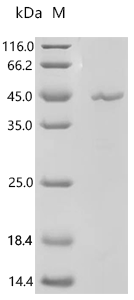
≥ 95% as determined by SDS-PAGE.
Activity
Not Test
Target Names
Uniprot No.
Research Area
Neuroscience
Alternative Names
Obesity factor
Species
Sus scrofa (Pig)
Source
E.coli
Expression Region
22-167aa
Target Protein Sequence
VPIWRVQDDTKTLIKTIVTRISDISHMQSVSSKQRVTGLDFIPGLHPVLSLSKMDQTLAIYQQILTSLPSRNVIQISNDLENLRDLLHLLASSKSCPLPQARALETLESLGGVLEASLYSTEVVALSRLQGALQDMLRQLDLSPGC
Note: The complete sequence may include tag sequence, target protein sequence, linker sequence and extra sequence that is translated with the protein sequence for the purpose(s) of secretion, stability, solubility, etc.
If the exact amino acid sequence of this recombinant protein is critical to your application, please explicitly request the full and complete sequence of this protein before ordering.
Mol. Weight
42.6 kDa
Protein Length
Full Length of Mature Protein
Tag Info
C-terminal mFc2a-tagged
Form
Liquid or Lyophilized powder
Note: We will preferentially ship the format that we have in stock, however, if you have any special requirement for the format, please remark your requirement when placing the order, we will prepare according to your demand.
Note: We will preferentially ship the format that we have in stock, however, if you have any special requirement for the format, please remark your requirement when placing the order, we will prepare according to your demand.
Buffer
If the delivery form is liquid, the default storage buffer is Tris/PBS-based buffer, 5%-50% glycerol. If the delivery form is lyophilized powder, the buffer before lyophilization is Tris/PBS-based buffer, 6% Trehalose.
Reconstitution
We recommend briefly centrifuging the vial prior to opening to bring the contents to the bottom. Reconstitute the lyophilized protein in sterile deionized water to a recommended concentration of 0.1–1.0 mg/mL. If used immediately after reconstitution, glycerol is not required. If not for immediate use, after the protein is completely dissolved, add glycerol to a final concentration of 5%–50% (default: 50%), aliquot as needed, and store at -20℃/-80℃ for long-term storage. If dilution is needed during subsequent use, dilute with the same buffer as the protein, but without stabilizers (e.g., glycerol, trehalose, etc).
Troubleshooting and FAQs
Storage Condition
Store at -20°C/-80°C upon receipt, aliquoting is necessary for mutiple use. Avoid repeated freeze-thaw cycles.
Shelf Life
The shelf life is related to many factors, storage state, buffer ingredients, storage temperature and the stability of the protein itself.
Generally, the shelf life of liquid form is 6 months at -20°C/-80°C. The shelf life of lyophilized form is 12 months at -20°C/-80°C.
Generally, the shelf life of liquid form is 6 months at -20°C/-80°C. The shelf life of lyophilized form is 12 months at -20°C/-80°C.
Notes
Repeated freezing and thawing is not recommended. Store working aliquots at 4°C for up to one week.
Datasheet & COA
Please contact us to get it.
Customer Reviews and Q&A
■ Customer Reviews
There are currently no reviews for this product.
Target Background
Function
Key player in the regulation of energy balance and body weight control. Once released into the circulation, has central and peripheral effects by binding LEPR, found in many tissues, which results in the activation of several major signaling pathways. In the hypothalamus, acts as an appetite-regulating factor that induces a decrease in food intake and an increase in energy consumption by inducing anorexinogenic factors and suppressing orexigenic neuropeptides, also regulates bone mass and secretion of hypothalamo-pituitary-adrenal hormones. In the periphery, increases basal metabolism,...
Gene References into Functions
- study has allowed a transcriptional characterization of LEP and LEPR isoforms on a range of tissues. Their expression patterns seem to indicate that both molecules develop peripheral roles apart from their known hypothalamic signal transduction function
- The lack of effect of heat stress on the expression of leptin suggests that this peptide may not be involved in the reduction of feed intake of HS acclimated pigs.
- A high variability of the LEP was detected in the different analysed populations providing new data for the existence of two domestication centres in Asia.
- The presence of leptin and ObR-b varies across parities and is more intense in the uterus, ovaries and hypothalamus of females that were cycling before culling than in those having cystic ovaries.
- Studied 3'UTR leptin polymorphism regulatory sequences' affect on gene expression and their association with production traits.
- These results suggest that LEPR, MC4R, PIK3C3 and VRTN are useful markers for accurately predicting breeding values in Duroc pigs.
- Data showing changes in expression patterns of LEP/LEPR in endometrium/chorioallantoic membrane during placentation/fetal development suggest role for LEP/LEPR complex at early stages of pregnancy, possibly affecting the attachment process.
- Another funning discovery is ob-Rb mRNA in porcine endometrium was mainly negative-regulated by leptin
- Characterization of a distinctive pattern of periovulatory leptin secretion and its relationship with ovulation rate and luteal function in swine with obesity/leptin resistance
- Leptin and leptin receptor are expressed in porcine luteal cells, and there is a modulatory effect of LH, estradiol (E) and progesterone (P) on leptin mRNA expression as well as E and P on leptin secretion by those cells obtained in early pregnancy.
- The present study aimed to determine the effects of breed and sex on growth patterns and metabolic features of advanced-pregnancy foetuses from lean and obese/leptin resistant swine.
- Locally produced leptin plays a role in the regulation of porcine reproduction at the ovarian level and exerts a direct effect on follicles. Differences in long isoform of leptin receptor gene expression varies in the ovaries of pregnant and cyclic pigs.
- These results indicate that leptin and its receptors are expressed in porcine luteal cells and suggest that estradiol and progesterone affect leptin mRNA expression and leptin secretion during the mid-luteal phase of the estrous cycle.
- results suggest the T alleles of both LEP g.1387C>T and LEPR c.1987C>T, which are fixed in the Iberian pigs, would lead to an increase in growth, fatness and saturated fatty acid content in fat, which could be explained by an increased feed intake
- Linkage disequilibrium analysis among MC4R, LEP and H-FABP revealed that these genes were independent.
- role of transcription factor p53 and the metabolic hormone leptin, in controlling basic functions (proliferation, apoptosis and secretory activity) of ovarian cells
- The expression levels of leptin in the ovary during mid- and late-luteal phase of the oestrous cycle as well as during days 14-16 and 30-32 of pregnancy is reported.
- These results suggest that SNP G-2863A is a potential DNA marker for backfat thickness and has a regulatory role in leptin transcription.
- Increases in epicardial perivascular adipose tissue leptin exacerbate coronary endothelial dysfunction in MetS via a PKC-beta-dependent pathway.
- These results indicate that both leptin and OB-Rb are synthesized in the porcine hypothalamus and participate in control of reproduction during the oestrous cycle and early pregnancy.
- leptin enhances oocyte nuclear maturation via activation of the MAPK pathway.
- Leptin mRNA expression in the porcine hypothalamus and pituitary gland changes with time in pregnancy.
- The expression of leptin mRNA is higher in Large White pigs than that in Erhualian pigs.
- a transient increase in insulin during fasting is effective in restoring leptin concentrations; in addition, leptin levels in follicular fluid parallel those in plasma
- the role of leptin is to restrict the stage of corpora lutea formation
- LEP genotypes had significant influence on performance traits, and can be considered as potential genetic markers for selection.
- A 245 bp fragment of the porcine leptin gene promoter in the proximity of the transcription start site, is described.
- Leptin gene and protein expression in porcine endometrium, myometrium and trophoblast indicated that locally synthetized leptin can participate in control of pig reproduction.
- By sequencing LEP genes in 72 pigs belonging to lean (Large White and Duroc), fat (Meishan and Casertana) breeds and also Wild Boar, 98 polymorphic sites, of which 91 were novel, were found in the Leptin sequence.
- These data demonstrated that feed allowance level has important consequence on embryo survival, embryo development and uterine development, possibly mediated by changes in concentrations of reproductive hormones.
- polymorphisms in the leptin gene of 112 pigs and compare the maternal and paternal lineage of Pietrain and Large White breeds that underwent a divergent selection for over 30 years
- Therefore, our findings suggest a possible involvement of leptin in endocrine or autocrine/paracrine control of porcine male reproductive structures.
- This article describes the interaction between conjugated linoleic acids and leptin in the white adipose tissue of heavy pigs and hypothesized that there is an increased noradrenergic stimulation of lipolysis directly in the target tissue.
Subcellular Location
Secreted.
Protein Families
Leptin family
Database Links
KEGG:
STRING:
UniGene: