

Recombinant Human T-cell leukemia virus 1 Envelope glycoprotein gp62 (env), partial - E.coli

Referência CSB-EP361037HQJa2-20ug
Tamanho : 20ug
Marca : Cusabio
Contactar o distribuidor local :

Telefone : +1 850 650 7790
| Abbreviation | Recombinant Human T-cell leukemia virus 1 env protein, partial |
| MSDS | |
| Image | |
Product Details
Purity
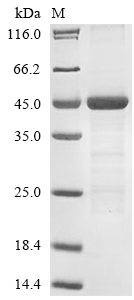
≥ 85% as determined by SDS-PAGE.
Target Names
env
Uniprot No.
Research Area
Metabolism
Alternative Names
env; Envelope glycoprotein gp62; Env polyprotein) [Cleaved into: Surface protein; SU; Glycoprotein 46; gp46); Transmembrane protein; TM; Glycoprotein 21; gp21)]
Species
Human T-cell leukemia virus 1 (strain Japan ATK-1 subtype A) (HTLV-1)
Source
E.coli
Expression Region
21-312aa
Target Protein Sequence
DYSPSCCTLTIGVSSYHSKPCNPAQPVCSWTLDLLALSADQALQPPCPNLVSYSSYHATYSLYLFPHWTKKPNRNGGGYYSASYSDPCSLKCPYLGCQSWTCPYTGAVSSPYWKFQHDVNFTQEVSRLNINLHFSKCGFPFSLLVDAPGYDPIWFLNTEPSQLPPTAPPLLPHSNLDHILEPSIPWKSKLLTLVQLTLQSTNYTCIVCIDRASLSTWHVLYSPNVSVPSSSSTPLLYPSLALPAPHLTLPFNWTHCFDPQIQAIVSSPCHNSLILPPFSLSPVPTLGSRSRR
Note: The complete sequence may include tag sequence, target protein sequence, linker sequence and extra sequence that is translated with the protein sequence for the purpose(s) of secretion, stability, solubility, etc.
If the exact amino acid sequence of this recombinant protein is critical to your application, please explicitly request the full and complete sequence of this protein before ordering.
Mol. Weight
36.0 kDa
Protein Length
Partial
Tag Info
N-terminal 6xHis-SUMO-tagged
Form
Liquid or Lyophilized powder
Note: We will preferentially ship the format that we have in stock, however, if you have any special requirement for the format, please remark your requirement when placing the order, we will prepare according to your demand.
Note: We will preferentially ship the format that we have in stock, however, if you have any special requirement for the format, please remark your requirement when placing the order, we will prepare according to your demand.
Buffer
If the delivery form is liquid, the default storage buffer is Tris/PBS-based buffer, 5%-50% glycerol. If the delivery form is lyophilized powder, the buffer before lyophilization is Tris/PBS-based buffer, 6% Trehalose.
Reconstitution
We recommend briefly centrifuging the vial prior to opening to bring the contents to the bottom. Reconstitute the lyophilized protein in sterile deionized water to a recommended concentration of 0.1–1.0 mg/mL. If used immediately after reconstitution, glycerol is not required. If not for immediate use, after the protein is completely dissolved, add glycerol to a final concentration of 5%–50% (default: 50%), aliquot as needed, and store at -20℃/-80℃ for long-term storage. If dilution is needed during subsequent use, dilute with the same buffer as the protein, but without stabilizers (e.g., glycerol, trehalose, etc).
Troubleshooting and FAQs
Storage Condition
Store at -20°C/-80°C upon receipt, aliquoting is necessary for mutiple use. Avoid repeated freeze-thaw cycles.
Shelf Life
The shelf life is related to many factors, storage state, buffer ingredients, storage temperature and the stability of the protein itself.
Generally, the shelf life of liquid form is 6 months at -20°C/-80°C. The shelf life of lyophilized form is 12 months at -20°C/-80°C.
Generally, the shelf life of liquid form is 6 months at -20°C/-80°C. The shelf life of lyophilized form is 12 months at -20°C/-80°C.
Notes
Repeated freezing and thawing is not recommended. Store working aliquots at 4°C for up to one week.
Datasheet & COA
Please contact us to get it.
Customer Reviews and Q&A
■ Customer Reviews
There are currently no reviews for this product.
Target Background
Function
The surface protein (SU) attaches the virus to the host cell by binding to its receptor. This interaction triggers the refolding of the transmembrane protein (TM) and is thought to activate its fusogenic potential by unmasking its fusion peptide. Fusion occurs at the host cell plasma membrane.; The transmembrane protein (TM) acts as a class I viral fusion protein. Under the current model, the protein has at least 3 conformational states: pre-fusion native state, pre-hairpin intermediate state, and post-fusion hairpin state. During viral and target cell membrane fusion, the coiled coil regions...
Subcellular Location
[Transmembrane protein]: Virion membrane; Single-pass type I membrane protein. Host cell membrane; Single-pass type I membrane protein.; [Surface protein]: Virion membrane; Peripheral membrane protein. Host cell membrane; Peripheral membrane protein.