

Rat Anti-Mouse CD24-APC

Referência 1590-11
Tamanho : 0.1mg
Marca : Southern Biotech
Contactar o distribuidor local :
 Telefone : +1 850 650 7790
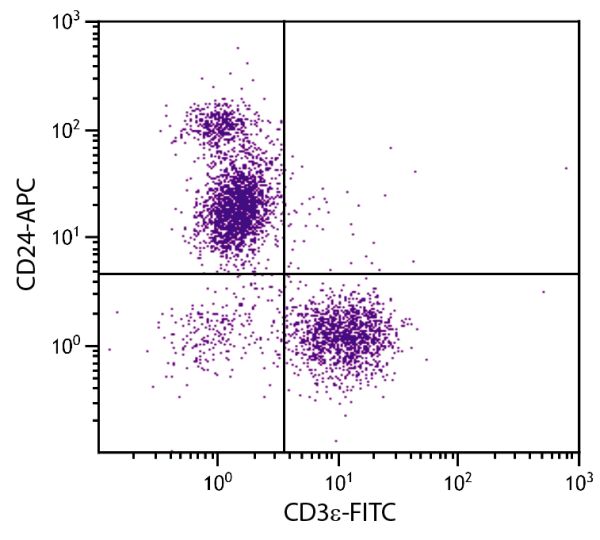

| Clone | 91 |
|---|---|
| Isotype | Rat IgG2aκ |
| Isotype Control | Rat IgG2a-APC (KLH/G2a-1-1) |
| Specificity | Mouse CD24 |
| Alternative Names | Heat stable antigen, HSA |
| Description | CD24, also known as heat stable antigen, is a phosphatidylinositol-linked cell surface glycoprotein that is expressed at all stages of B cell development and on most thymocytes. The absence of expression from mature T cells is closely associated with their maturation from CD4+CD8+CD24+ thymocytes to either CD4+CD8-CD24- or CD4-CD8+CD24- T cells. CD24 is also present on mouse granulocytes, monocytes, Langerhans cells and erythrocytes. Its ligand is P-selectin (CD62P). CD24 may play a role in regulation of B cell proliferation and differentiation, and it has been proposed that heat stable antigen promotes homotypic adhesion between B lymphocytes. |
| Conjugate | APC (Allophycocyanin) |
| Buffer Formulation | Phosphate buffered saline containing < 0.1% sodium azide and a stabilizer |
| Clonality | Monoclonal |
| Concentration | 0.1 mg/mL |
| Volume | 1.0 mL |
| Recommended Storage | 2-8°C; Avoid exposure to light; Do not freeze |
| Applications | Flow Cytometry – Quality tested 2 Immunohistochemistry-Frozen Sections – Reported in literature 1 |
| RRID Number | AB_2794994 |
| Gene ID | 12484 (Mouse) |
| Gene ID Symbol | Cd24a (Mouse) |
| Gene ID Aliases | HSA; Cd24; Ly-52; nectadrin |
| UniProt ID | P24807 (Mouse) |
| UniProt Name | CD24_MOUSE (Mouse) |
Documentation
Technical Bulletin Safety Datasheet
Certificate of Analysis Lookup
Enter the Catalog Number and Lot Number for the Certificate of Analysis you wish to view
- 1. Frings PW, Van Elssen CH, Wieten L, Matos C, Hupperets PS, Schouten HC, et al. Elimination of the chemotherapy resistant subpopulation of 4T1 mouse breast cancer by haploidentical NK cells cures the vast majority of mice. Breast Cancer Res Treat. 2011;130:773-81. (IHC-FS)
- 2. Zhou X, Bailey-Bucktrout S, Jeker LT, Penaranda C, Martinez-Llordella M, Ashby M, et al. Foxp3 instability leads to the generation of pathogenic memory T cells in vivo. Nat Immunol. 2009;10:1000-7. (FC)
