


Inquiry
Dispatch Time: About 3 working days
- Product Name
- PerCP-Cy5.5 Anti-Human CD158b/j Antibody(DX27)
- Catalogue No.
- PCP55-30251
- Form
- liquid
- Conjugation
- PerCP-Cy5.5
- Conjugation Information
- PerCP-Cy5.5 is designed to be excited by the blue laser (488 nm) and detected using an optical filter centered near 675 nm (e.g., a 690/50 nm bandpass filter).
- Clonality
- Monoclonal
- Isotype
- IgG2a, κ
- Clone ID
- DX27
- Storage
- PBS with 0. 1% sodium azide, 1%BSA, pH 7.3, 2-8℃ for 12 months (Avoid repeated freeze / thaw cycles.)
Application
- Tested Applications
- FC
- Recommended dilution
- Volume per test: 5μL. Each lot of this antibody is quality control tested by flow cytometric analysis. The amount of the reagent is suggested to be used 5 µL of antibody per test (million cells in 100 µL staining volume or per 100 µL of whole blood). Please check your vial before the experiment. Since applications vary, the appropriate dilutions must be determined for individual use.
Validated Images
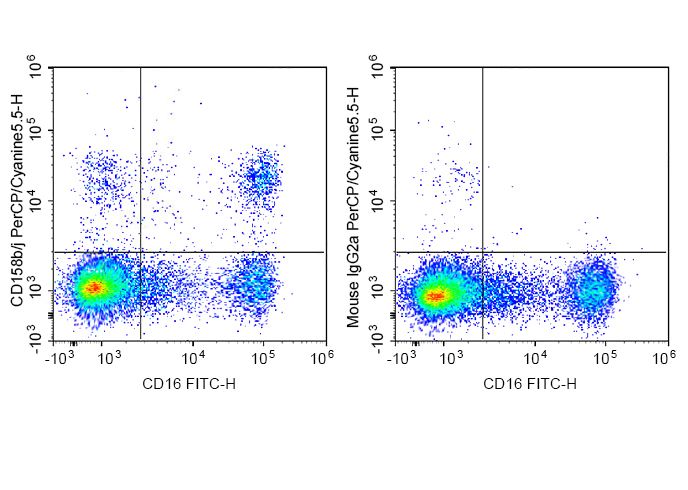 Staining of normal human peripheral blood cells with FITC Anti-Human CD16 Antibody and PerCP-Cy5.5 Anti-Human CD158b/j Antibody(DX27) (left) or PerCP-Cy5.5 Mouse IgG2a, κ Isotype Control (right). Cells in the lymphocytes gate were used for analysis.
- Background
- CD158b is expressed on natural killer cells and a subset of T cells. It is a member of the immunoglobulin superfamily containing two immunoglobulin C2-type domains. Both variants and alternative isoforms of CD158b have been reported. The interaction of CD158b with specific HLA-C antigens on a target cell (HLA-Cw1, HLA-Cw3, HLA-Cw7 alleles, for example) inhibits cytotoxicity and prevents target cell lysis and death. The interactions between KIR and MHC class I are thought to be important in NK cell and T cell regulation following antigen stimulation. The absence of ligands for KIRs may lower the threshold for activation through activating receptors and increase inflammation and susceptibility to autoimmune disease.