PECAM1 Capture Antibody

Referência OAOA21663
Tamanho : 100µg
Marca : Aviva Systems Biology
Contactar o distribuidor local :

Telefone : +1 850 650 7790
PECAM1 Capture Antibody (OAOA21663)
| Datasheets/Manuals | Printable datasheet for PECAM1 Capture Antibody (OAOA21663) |
|---|
| Predicted Species Reactivity | Human |
|---|---|
| Product Format | Stored in PBS (pH 7.4) containing 0.05% sodium azide and up to 5% trehalose |
| Clonality | Monoclonal |
| Clone | OTI2B5 |
| Isotype | IgG1 |
| Host | Mouse |
| Application | MlpxA |
| Additional Information | Matched ELISA Pair: OAOA22118 |
| Reconstitution and Storage | -20°C |
| Immunogen | Full length human recombinant protein of human PECAM1 (NM_000442) produced in HEK293T cell. |
| Concentration | 0.5 mg/ml |
| Dilution | 1:100 - 1:1000 |
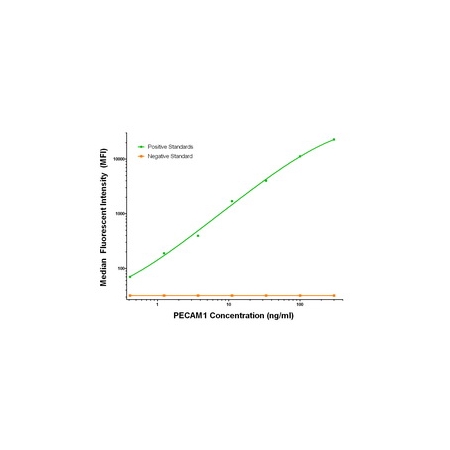
| Description | PECAM1 mouse monoclonal capture antibody, validated for Luminex assays |
| Gene Symbol | PECAM1 |
|---|---|
| Gene Full Name | platelet and endothelial cell adhesion molecule 1 |
| Alias Symbols | CD31, CD31 antigen, CD31/EndoCAM, endoCAM, GPIIA', PECA1, PECAM-1, platelet endothelial cell adhesion molecule, platelet endothelial cell adhesion molecule-1. |
| NCBI Gene Id | 5175 |
| Protein Name | Homo sapiens platelet and endothelial cell adhesion molecule 1 (PECAM1), mRNA|Platelet endothelial cell adhesion molecule |
| Description of Target | Cell adhesion molecule which is required for leukocyte transendothelial migration (TEM) under most inflammatory conditions (PubMed:19342684, PubMed:17580308). Tyr-690 plays a critical role in TEM and is required for efficient trafficking of PECAM1 to and from the lateral border recycling compartment (LBRC) and is also essential for the LBRC membrane to be targeted around migrating leukocytes (PubMed:19342684). Trans-homophilic interaction may play a role in endothelial cell-cell adhesion via cell junctions (PubMed:27958302). Heterophilic interaction with CD177 plays a role in transendothelial migration of neutrophils (PubMed:17580308). Homophilic ligation of PECAM1 prevents macrophage-mediated phagocytosis of neighboring viable leukocytes by transmitting a detachment signal (PubMed:12110892). Promotes macrophage-mediated phagocytosis of apoptotic leukocytes by tethering them to the phagocytic cells; PECAM1-mediated detachment signal appears to be disabled in apoptotic leukocytes (PubMed:12110892). Modulates bradykinin receptor BDKRB2 activation (PubMed:18672896). Regulates bradykinin- and hyperosmotic shock-induced ERK1/2 activation in endothelial cells (PubMed:18672896). Induces susceptibility to atherosclerosis (By similarity). |
| Uniprot ID | P16284 |
| Protein Accession # | NP_000433 |
| Nucleotide Accession # | https://www.ncbi.nlm.nih.gov/nuccore/NM_000442 |