OTC Antibody - N-terminal region - HRP

Referência ARP41766_T100-HRP
Tamanho : 100ul
Marca : Aviva Systems Biology
Contactar o distribuidor local :

Telefone : +1 850 650 7790
OTC Antibody - N-terminal region : HRP (ARP41766_T100-HRP)

| Datasheets/Manuals | Printable datasheet for anti-OTC (ARP41766_T100-HRP) antibody |
|---|
| Publications | Yu, W. et al. Lysine 88 acetylation negatively regulates ornithine carbamoyltransferase activity in response to nutrient signals. J. Biol. Chem. 284, 13669-75 (2009). WB, Goat, Dog, Bovine, Pig, Horse, Rat, Human, Mouse, Sheep, Rabbit, Guinea pig 19318352 Walters, M. W. & Wallace, K. B. Urea cycle gene expression is suppressed by PFOA treatment in rats. Toxicol. Lett. 197, 46-50 (2010). WB, Goat, Dog, Bovine, Pig, Horse, Rat, Human, Mouse, Sheep, Rabbit, Guinea pig 20452409 Hallows, W. C. et al. Sirt3 promotes the urea cycle and fatty acid oxidation during dietary restriction. Mol. Cell 41, 139-49 (2011). IP, Goat, Dog, Bovine, Pig, Horse, Rat, Human, Mouse, Sheep, Rabbit, Guinea pig 21255725 |
|---|---|
| Predicted Species Reactivity | Human, Mouse, Rat, Cow, Dog, Goat, Guinea Pig, Horse, Pig, Rabbit, Sheep |
| Product Format | Liquid. Purified antibody is supplied in high phosphate PBS, 100 mm phosphate, 150 mM NaCl, pH 7.6. |
| Clonality | Polyclonal |
| Host | Rabbit |
| Conjugation | HRP: Horseradish Peroxidase |
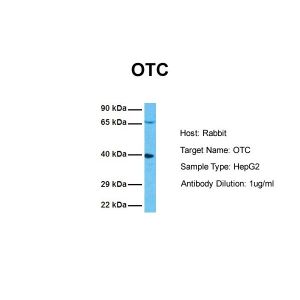
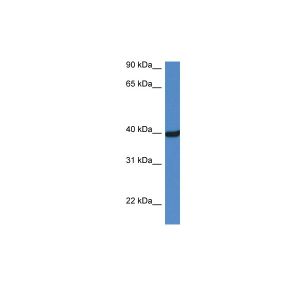
| Application | IHC, WB |
| Reconstitution and Storage | All conjugated antibodies should be stored in light-protected vials or covered with a light protecting material (i.e. aluminum foil). Conjugated antibodies are stable for at least 12 months at 4C. If longer storage is desired (24 months), conjugates may be diluted with up to 50% glycerol and stored at -20C to -80C. Freezing and thawing conjugated antibodies will compromise enzyme activity as well as antibody binding. |
| Immunogen | The immunogen is a synthetic peptide directed towards the N terminal region of human OTC |
| Predicted Homology Based on Immunogen Sequence | Cow: 100%; Dog: 100%; Goat: 100%; Guinea Pig: 93%; Horse: 100%; Human: 100%; Mouse: 100%; Pig: 100%; Rabbit: 93%; Rat: 100%; Sheep: 100% |
| Peptide Sequence | Synthetic peptide located within the following region: AFRNGHNFMVRNFRCGQPLQNKVQLKGRDLLTLKNFTGEEIKYMLWLSAD |
| Concentration | 0.5 mg/ml |
| Blocking Peptide | For anti-OTC (ARP41766_T100-HRP) antibody is Catalog # AAP41766 (Previous Catalog # AAPP10814) |
| Reference | Tanaka,A., (2005) J. Gastroenterol. 40 (1), 106-107 |
|---|---|
| Gene Symbol | OTC |
| Gene Full Name | Ornithine carbamoyltransferase |
| Alias Symbols | OCTD, OTCD |
| NCBI Gene Id | 5009 |
| Protein Name | Ornithine carbamoyltransferase, mitochondrial |
| Description of Target | OTC is a mitochondrial matrix enzyme. Missense, nonsense, and frameshift mutations in this enzyme lead to ornithine transcarbamylase deficiency, which causes hyperammonemia. Since the gene for this enzyme maps close to that for Duchenne muscular dystrophy, it may play a role in that disease also.This nuclear gene encodes a mitochondrial matrix enzyme. Missense, nonsense, and frameshift mutations in this enzyme lead to ornithine transcarbamylase deficiency, which causes hyperammonemia. Since the gene for this enzyme maps close to that for Duchenne muscular dystrophy, it may play a role in that disease also. |
| Uniprot ID | P00480 |
| Protein Accession # | NP_000522 |
| Nucleotide Accession # | NM_000531 |
| Protein Size (# AA) | 354 |
| Molecular Weight | 39kDa |
| Protein Interactions | OTC; TOMM20; |