

Mouse Collagen alpha-1(I) chain (COL1A1) ELISA kit

Referência CSB-EL005727MO-96T
Tamanho : 96T
Marca : Cusabio
Contactar o distribuidor local :

Telefone : +1 850 650 7790
 SDS
| Size | 96T,5×96T,10×96T |
Product Details
Target Name
collagen, type I, alpha 1
Associated names
Col1a1 ELISA kit; Cola1Collagen alpha-1(I) chain ELISA kit; Alpha-1 type I collagen ELISA kit
Abbreviation
Uniprot No.
Species
Mus musculus (Mouse)
Sample Types
serum, plasma, tissue homogenates
Detection Range
0.312 ng/mL-20 ng/mL
Sensitivity
0.078 ng/mL
Assay Time
1-5h
Sample Loading Volume
50-100ul
Detection Wavelength
450 nm
Research Area
Signal Transduction
Assay Principle
quantitative
Measurement
Sandwich
Precision
| Intra-assay Precision (Precision within an assay): CV%<8% | ||||||
| Three samples of known concentration were tested twenty times on one plate to assess. | ||||||
| Inter-assay Precision (Precision between assays): CV%<10% | ||||||
| Three samples of known concentration were tested in twenty assays to assess. | ||||||
Linearity
| To assess the linearity of the assay, samples were spiked with high concentrations of mouse COL1A1 in various matrices and diluted with the Sample Diluent to produce samples with values within the dynamic range of the assay. | ||||||
| Sample | Serum(n=4) | |||||
| 1:1 | Average % | 88 | ||||
| Range % | 81-92 | |||||
| 1:2 | Average % | 102 | ||||
| Range % | 95-105 | |||||
| 1:4 | Average % | 91 | ||||
| Range % | 85-95 | |||||
| 1:8 | Average % | 97 | ||||
| Range % | 91-101 | |||||
Recovery
| The recovery of mouse COL1A1 spiked to levels throughout the range of the assay in various matrices was evaluated. Samples were diluted prior to assay as directed in the Sample Preparation section. | ||||||
| Sample Type | Average % Recovery | Range | ||||
| Serum (n=5) | 88 | 82-92 | ||||
| EDTA plasma (n=4) | 100 | 90-104 | ||||
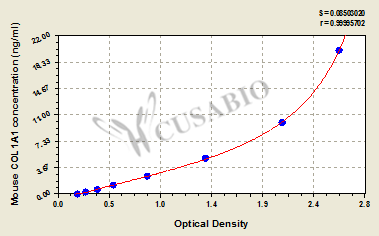
Typical Data
| These standard curves are provided for demonstration only. A standard curve should be generated for each set of samples assayed. | |||||||||||||||||||||||||||||||||||||||||||||||||||||||||||||||
| |||||||||||||||||||||||||||||||||||||||||||||||||||||||||||||||
ELISA Data Analysis
Troubleshooting
and FAQs
and FAQs
Storage
Store at 2-8°C. Please refer to protocol.
Shelf Life
6 months
Description
This Mouse COL1A1 ELISA Kit was designed for the quantitative measurement of Mouse COL1A1 protein in serum, plasma, tissue homogenates. It is a Sandwich ELISA kit, its detection range is 0.312 ng/mL-20 ng/mL and the sensitivity is 0.078 ng/mL.
Citations
- S Pan,Annals of hepatology,2023
- HS Lim,Evidence-based complementary and alternative medicine,2022
- Figure S, et al,Am Soc Clin Investig,2019
- Zhang J.et al,Sci Rep. ,2017
- Chen L.et al,Respiratory research,2016
Customer Reviews and Q&A
There are currently no reviews for this product.
Target Background
Function
(From Uniprot)
(From Uniprot)
Type I collagen is a member of group I collagen (fibrillar forming collagen).
Gene References into Functions
- Our studies demonstrate that a collagen-I-dense ECM can potently alter hormonal signals to drive the progression of ERalpha + breast cancer, increasing intravasation and pulmonary metastases.
- Offspring that inherited the osteogenesis imperfect (OI) and high bone mass alleles had higher bone mass and strength than mice that inherited the OI allele alone.
- a surface population of Hsp90 extracellularly binds TGFbetaRI and this complex behaves as an active participant in collagen production in TGFbeta-activated fibroblasts.
- Gremlin1 accelerates hepatic stellate cell activation through upregulation of TGF-B1, alpha-SMA, and COL1a1 expression in a liver fibrosis disease model.
- collagen-I-mediated inhibition of proplatelet formation is specifically controlled by GPVI.
- Col1a1Jrt/+ mutant mice produce craniofacial and dental defects consistent with osteogenesis imperfecta and Ehlers-Danlos syndrome
- the rate of collagen I degradation was increased in Poldip2(+/-) vs. Poldip2(+/+) MASMs. Conversely, activation of the PI3K/Akt/mTOR signaling pathway, involved in regulation of protein synthesis, was significantly elevated in Poldip2(+/-) MASMs as was beta1-integrin expression.
- These data provided a plausible mechanism linking maternal vitamin D deficiency with altered postnatal lung function.
- Col1 expression was seen in the cartilage zone of the mandibular condyle cartilage.
- the Col1a1Jrt/+ mouse model of severe OI has hypersensitivity to mechanical and thermal stimuli, consistent with a state of chronic pain
- HRG binds to alpha2 integrin through low-affinity interactions in a heparin sulfate-independent manner, thereby blocking endothelial cells adhesion to collagen I.
- Calreticulin in mediates vascular smooth muscle cell responses to injury through the regulation of collagen deposition and neointima formation.
- Homocysteine Induces Collagen I Expression by Downregulating Histone Methyltransferase G9a
- These data suggested that intestinal epithelial cells were injured after IM treatment through the pVHL overexpression-induced degradation of collagen I or HIF-1alpha.
- lipid nanoparticles loaded with small interfering RNA to the procollagen alpha1(I) gene specifically reduce total hepatic collagen content without detectable side effects, potentially qualifying as a therapy for fibrotic liver diseases
- Collagen Ialpha1 matricryptin p1158/59 facilitates left ventricle remodeling post-myocardial infarction by regulating scar formation through targeted extracellular matrix generation and stimulation of angiogenesis.
- low-level laser therapy influences the expression of col1a1 and vegf in a mouse fibroblast cell line.
- Hgh fat diet increased TGFbeta1 protein expression, Smad3 activation, and collagen deposition in skeletal muscle, and exercise attenuated TGFbeta1 protein expression and collagen deposition in skeletal muscle.
- During heart valve development, Krox20-mediated activation of fibrillar Col1a1 and Col3a1 genes is crucial to avoid postnatal degeneration of the aortic valve leaflets.
- Data indicate significantly reduced volumetric density of elastin and collagen and thinner skin dermis were observed in Marfan mice.
- Fibrocytes are not an essential source of type I collagen during lung fibrosis.
- Allele-specific Col1a1 silencing reduces mutant collagen in fibroblasts from Brtl mouse, a model for classical osteogenesis imperfecta.
- These findings reveal a novel aging cascade whereby resistance to collagen cleavage accelerates cellular aging.
- Hypoxic tumor environments exhibit disrupted collagen I fibers and low macromolecular transport.
- results indicate that Hrd1 plays an important role in the maturation of collagen I in renal fibrosis, and that Sec23A pathway is required for ER-to-Golgi procollagen trafficking to promote collagen synthesis
- Data indicate a significantly increased expression of type I collagen, TIMP-2, TGF-beta, PAI-1 and RAGE in diabetic db/db cells.
- Analysis of mutant mouse lines for Col1a1 and Jag1 (Delta-Notch pathway) that both showed clear alterations in several bone-related parameters
- the absence of integrin alpha2beta1 alleviates the effects of age related bone degradation through over-expression of collagen type I.
- Data indicate serine-threonine kinase receptor-associated protein (STRAP) as a novel regulator of the coordinated translation of collagen alpha1(I) and alpha2(I) mRNAs.
- This study deministrated that collagen1alpha1 cells as a novel source of the fibrotic scar after spinal cord injury and shift the focus from the meninges to the vasculature during scar formation.
- DNA injection and electroporation of the testes showed that spermatogonia self-renewal ability was impaired remarkably with the loss-of-function of Col1a1.
- Strong transgenerational inheritance of these perturbations was observed only at transgenes integrated at the Col1a1 locus, where both activating and repressive chromatin modifications were heritable for multiple generations.
- Trps1 is identified as a potent inhibitor of Dspp expression and the subsequent mineralization of dentin.
- Hypermethylation of CpG sites in the promoter/exon 1 of COL1A1 may underlie reduced collagen synthesis at the transcriptional level in myopic scleras.
- we show that Prdm5 controls both Collagen I transcription and fibrillogenesis by binding inside the Col1a1 gene body and maintaining RNA polymerase II occupancy
- Higher MMP2 expression in mice on high-fat diet suggests its involvement in the reduction of COL1A1 protein abundance with high-fat diet.
- LH3-mediated glucosylation occurs at the specific molecular loci in the type I collagen molecule and plays critical roles in controlling collagen cross-linking, fibrillogenesis, and mineralization.
- atomistic simulations of a section of mouse type I heterotrimer and homotrimer collagen molecules
- Adult male offspring of OVA-sensitized /challenged dams exposed to maternal cigarette smokeS (OSM) displayed 1.8-fold greater collagen 1A1 mRNA levels.
- Fetal microchimeric cells switch on collagen type I transcription implicating mesenchymal lineage cells.
- study reports that vimentin filaments associate with collagen mRNAs in a 5'stem-loop sequence and LARP6-dependent manner and stabilize collagen mRNAs
- an important role of the 5' stem-loop in regulating type I collagen mRNA and protein expression
- Periostin is a PTH regulated extracellular matrix protein, partly co-localizing with collagen 1a1.
- SPARC is a critical regulator of collagen assembly. The type I collagen N-propeptide can effect the incorporation of collagen I into fibrillar extracellular matrix.
- Col(I)-Luc transgenic mice can be applied in the field of bone tissue engineering for monitoring bone repair processes and for investigating osteoinductive molecules or scaffolds.
- Transgenic (col1A1) Col3.6-HSD2 mice showed a low bone mass phenotype, with decreased ex vivo osteogenesis, which strengthens the concept that endogenous glucocorticoid signaling is required for optimal bone mass acquisition
- Exogenous VEGF restored resistance to oxidative stress in BAV SMCs to normal. Type I collagen gene induction was increased in BAV aorta.
- Demonstrate that collagen content is important to extralobar pulmonary artery stiffening caused by chronic hypoxia in Col1a1 transgenic mice.
- Interactions of alpha1(I)(3) homotrimers and normal alpha1(I)(2)alpha2(I) heterotrimers with fibroblast collagenase (MMP-1), were studied.
- Col1a1 gene regulatory elements have sites of stress-induced DNA duplex destabilization and nuclear scaffold/matrix association potential
Subcellular Location
Secreted, extracellular space, extracellular matrix.
Protein Families
Fibrillar collagen family
Tissue Specificity
Forms the fibrils of tendon, ligaments and bones. In bones the fibrils are mineralized with calcium hydroxyapatite.
Database Links
KEGG:
STRING:
UniGene: