


CD86 APC
Catalog #
Size
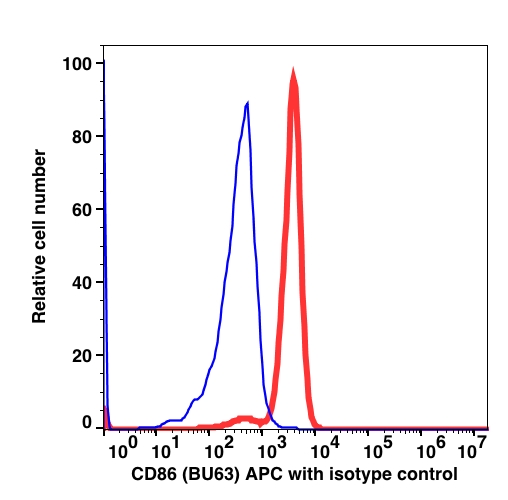
Monocyte gated PBMCs stained with CD86 APC (RED); Monocyte gated PBMCs stained with mouse IgG1 APC (BLUE).
| Conjugation | APC |
|---|---|
| Antigen | CD86 |
| Clone | BU63 |
| Isotype | IgG1, k |
| Applications | FC |
| Reactivity | Baboon, Cynomolgus monkey, Human, Rhesus |
| Host | Mouse |
| Clonality | Monoclonal |
| Primary/Secondary | Primary |
| Storage | 2-8°C |
| Status | RUO |
| Excitation Laser | Red (633nm) |
Description:
BU63 recognizes a ~70Kda surface antigen protein of Ig superfamily characterized as CD86 expressed by most antigen presenting cells (APC). Depending on the immunological condition, CD86 specifically binds with its two ligands CD28 and CD152 (CTLA-4) expressed by T cells. Binding with CD28, CD86 provides stimulatory signal and activates T cells whereas binding with CD152 (CTLA-4) CD86 provides inhibitory signal to T cells. Generally, high-level CD86 expression was noticed on peripheral monocytes, tissue macrophages and dendritic cells, and also on activated B cells. CD86 is useful in the clinical diagnosis of cancer cells including malignant Hodgkin’s and non-Hodgkin’s diseases.
BU63 recognizes a ~70Kda surface antigen protein of Ig superfamily characterized as CD86 expressed by most antigen presenting cells (APC). Depending on the immunological condition, CD86 specifically binds with its two ligands CD28 and CD152 (CTLA-4) expressed by T cells. Binding with CD28, CD86 provides stimulatory signal and activates T cells whereas binding with CD152 (CTLA-4) CD86 provides inhibitory signal to T cells. Generally, high-level CD86 expression was noticed on peripheral monocytes, tissue macrophages and dendritic cells, and also on activated B cells. CD86 is useful in the clinical diagnosis of cancer cells including malignant Hodgkin’s and non-Hodgkin’s diseases.