


CD4 APC-iFluor™ 700
Catalog #
Size
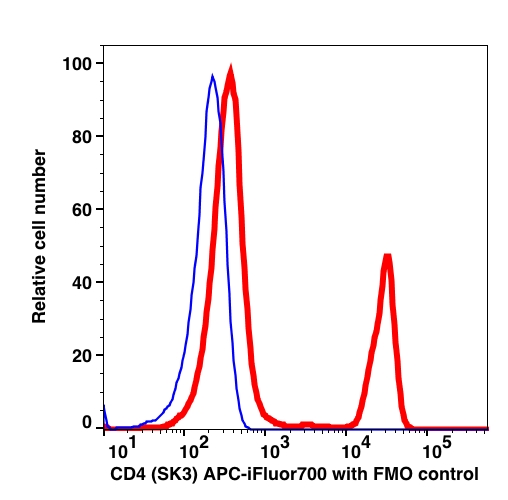
Lymphocytes gated PBMCs stained with CD4 (SK3) APC-iFluor700 (RED); Lymphocytes gated PBMCs are used as FMO control (BLUE).
| Conjugation | APC-iFluor™ 700 |
|---|---|
| Antigen | CD4 |
| Clone | SK3 |
| Isotype | IgG1, k |
| Applications | FC |
| Reactivity | Human |
| Host | Mouse |
| Clonality | Monoclonal |
| Primary/Secondary | Primary |
| Immunogen | Human peripheral blood T lymphocytes |
| Format | 0.09% sodium azide, 0.2% BSA (w/v), PBS pH 7.2 |
| Storage | 2-8°C |
| Status | RUO |
| Excitation Laser | Red (638nm) |
Description:
The clone SK3, a mouse monoclonal antibody selectively binds with a 55-59kD type I transmembrane glycoprotein and a member of the immunoglobulin superfamily. CD4 contains four extracellular Ig-like domains (D1-D4). The epitope for SK3 is located within the D3 domain of the protein, which has a structure resembling an Ig variable domain. Expression of CD4 is observed in subsets of T lymphocytes, monocytes, macrophages, and dendritic cells. Through interaction of MHC-II, CD4 facilitates cell-cell interaction, thymic differentiation, and activation of downstream signaling cascades. HIV infection of T-cells is instigated through binding of HIV to CD4. Binding of SK3 antibody blocks HIV infection through CD4 and also blocks the mixed lymphocyte reaction (MLR).
The clone SK3, a mouse monoclonal antibody selectively binds with a 55-59kD type I transmembrane glycoprotein and a member of the immunoglobulin superfamily. CD4 contains four extracellular Ig-like domains (D1-D4). The epitope for SK3 is located within the D3 domain of the protein, which has a structure resembling an Ig variable domain. Expression of CD4 is observed in subsets of T lymphocytes, monocytes, macrophages, and dendritic cells. Through interaction of MHC-II, CD4 facilitates cell-cell interaction, thymic differentiation, and activation of downstream signaling cascades. HIV infection of T-cells is instigated through binding of HIV to CD4. Binding of SK3 antibody blocks HIV infection through CD4 and also blocks the mixed lymphocyte reaction (MLR).