


CD4 Biotin
Catalog #
Size
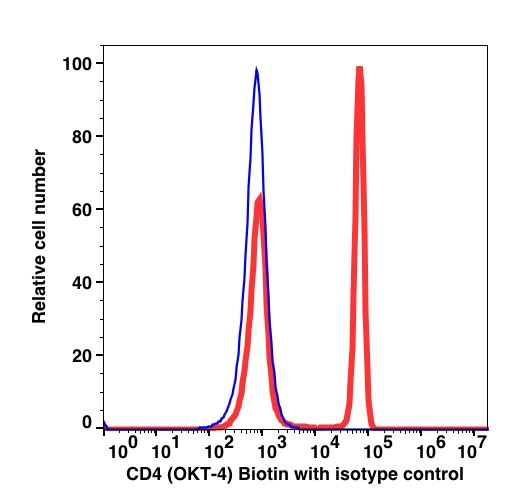
Lymphocyte-gated PBMCs stained with mouse CD4 biotin followed by staining with SA-PE (RED); Lymphocyte-gated PBMCs stained with IgG2b biotin followed by SA-PE (BLUE).
| Conjugation | Biotin |
|---|---|
| Antigen | CD4 |
| Clone | OKT4 |
| Isotype | IgG2b, k |
| Applications | FC |
| Reactivity | Cynomolgus monkey, Human, Rhesus |
| Host | Mouse |
| Clonality | Monoclonal |
| Primary/Secondary | Primary |
| Immunogen | Human peripheral blood T lymphocytes |
| Format | 0.09% sodium azide, PBS pH 7.2 |
| Storage | 2-8°C |
| Status | RUO |
Description:
CD4 is a 55kD type I transmembrane glycoprotein and a member of the immunoglobulin superfamily. It is a specific marker for T lymphocytes, monocytes, macrophages, and dendritic cells. Through interaction of MHC-II, CD4 facilitates cell-cell interaction, thymic differentiation, and activation of downstream signaling cascades. HIV infection of T-cells is instigated through binding of HIV to CD4. The OKT4 binds to the D3 domain of CD4 and does not inhibit HIV binding..
CD4 is a 55kD type I transmembrane glycoprotein and a member of the immunoglobulin superfamily. It is a specific marker for T lymphocytes, monocytes, macrophages, and dendritic cells. Through interaction of MHC-II, CD4 facilitates cell-cell interaction, thymic differentiation, and activation of downstream signaling cascades. HIV infection of T-cells is instigated through binding of HIV to CD4. The OKT4 binds to the D3 domain of CD4 and does not inhibit HIV binding..