


CD38 APC
Catalog #
Size
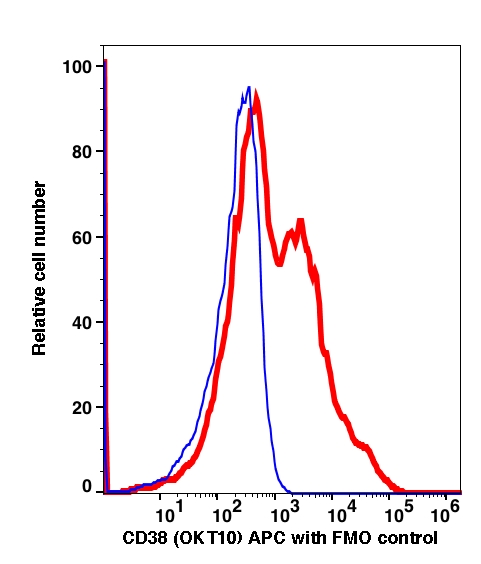
Lymphocytes-gated PBMCs stained with CD38 (OKT10) APC (RED); Lymphocytes-gated PBMCs are used as FMO control (BLUE).
| Conjugation | APC |
|---|---|
| Antigen | CD38 |
| Clone | OKT10 |
| Isotype | IgG1, k |
| Applications | FC |
| Reactivity | Baboon, Cynomolgus monkey, Human, Rhesus |
| Host | Mouse |
| Clonality | Monoclonal |
| Primary/Secondary | Primary |
| Immunogen | Human acute lymphoblastic leukaemia cells |
| Format | 0.09% sodium azide, 0.2% BSA (w/v), PBS pH 7.2 |
| Storage | 2-8°C |
| Status | RUO |
| Excitation Laser | Red (633nm) |
Description:
The clone OKT10, a mouse monoclonal antibody, recognizes a 45 kDa, type II transmembrane cell surface glycoprotein known as CD38. The CD38 antigen is expressed on pre-B lymphocytes, plasma cells, thymocytes and monocytes. CD38 also presents on activated T lymphocytes, natural killer (NK) lymphocytes, myeloblasts, and erythroblasts. Antigen expression is detected during the early stage of T- and B-lymphocyte differentiation, then lost during the intermediate stage of maturation, only to reappear during the final stage of maturation. The CD38 antigen is expressed on 90% of CD34+ cells and is not expressed on pluripotent stem cells. CD38 is expressed in T- and B-acute lymphoblastic leukemia (ALL), Burkitt's lymphoma, multiple myeloma, acute myeloid leukemia (AML), and chronic lymphocytic leukemia (CLL).
The clone OKT10, a mouse monoclonal antibody, recognizes a 45 kDa, type II transmembrane cell surface glycoprotein known as CD38. The CD38 antigen is expressed on pre-B lymphocytes, plasma cells, thymocytes and monocytes. CD38 also presents on activated T lymphocytes, natural killer (NK) lymphocytes, myeloblasts, and erythroblasts. Antigen expression is detected during the early stage of T- and B-lymphocyte differentiation, then lost during the intermediate stage of maturation, only to reappear during the final stage of maturation. The CD38 antigen is expressed on 90% of CD34+ cells and is not expressed on pluripotent stem cells. CD38 is expressed in T- and B-acute lymphoblastic leukemia (ALL), Burkitt's lymphoma, multiple myeloma, acute myeloid leukemia (AML), and chronic lymphocytic leukemia (CLL).