

Insulin Protein, Human, Recombinant

Referência NB-64-55621-20ug
Tamanho : 20ug
Marca : Neo Biotech
Contactar o distribuidor local :
 Telefone : +1 850 650 7790
Remove All
Insulin Protein, Human, Recombinant
(Synonyms: MODY10, IRDN, insulin, INS, ILPR, IDDM2, IDDM1, IDDM) Copy Product InfoSynonyms: MODY10, IRDN, insulin, INS, ILPR, IDDM2, IDDM1, IDDM
Catalog No. TMPY-00395 Copy Product Info
Purity: 97.2%
INS (Insulin) is a Protein Coding gene. This gene encodes insulin, a peptide hormone that plays a vital role in the regulation of carbohydrate and lipid metabolism. After removal of the precursor signal peptide, proinsulin is post-translationally cleaved into three peptides: the B chain and A chain peptides, which are covalently linked via two disulfide bonds to form insulin, and C-peptide. The binding of insulin to the insulin receptor (INSR) stimulates glucose uptake. Diseases associated with INS include Hyperproinsulinemia and Maturity-Onset Diabetes Of The Young, Type 10. A multitude of mutant alleles with phenotypic effects has been identified, including insulin-dependent diabetes mellitus, permanent neonatal diabetes mellitus, maturity-onset diabetes of the young type 10, and hyperproinsulinemia.Cancer ImmunotherapyImmune CheckpointImmunotherapyTargeted Therapy
For research use only—not for human use. No sales to individuals. Use as intended only.
Select Batch
Purity:97.2%
Appearance:Lyophilized powder
Color:White
Contact us for more batch information
Product Information
Bioactivity
Chemical Properties
Storage & Solubility Information
| Bioactivity | Measured in a serum-free cell proliferation assay using MCF‑7 human breast cancer cells. The ED50 for this effect is typically 0.2-1 µg/mL. |
| Description | INS (Insulin) is a Protein Coding gene. This gene encodes insulin, a peptide hormone that plays a vital role in the regulation of carbohydrate and lipid metabolism. After removal of the precursor signal peptide, proinsulin is post-translationally cleaved into three peptides: the B chain and A chain peptides, which are covalently linked via two disulfide bonds to form insulin, and C-peptide. The binding of insulin to the insulin receptor (INSR) stimulates glucose uptake. Diseases associated with INS include Hyperproinsulinemia and Maturity-Onset Diabetes Of The Young, Type 10. A multitude of mutant alleles with phenotypic effects has been identified, including insulin-dependent diabetes mellitus, permanent neonatal diabetes mellitus, maturity-onset diabetes of the young type 10, and hyperproinsulinemia.Cancer ImmunotherapyImmune CheckpointImmunotherapyTargeted Therapy |
| Species | Human |
| Expression System | P. pastoris (Yeast) |
| Tag | Tag Free |
| Accession Number | P01308 |
| Construction | A DNA sequence encoding human insulin B chain (P01308)(Phe25-Lys53) and human insulin A chain (P01308)(Gly90-Asn110) was expressed with a linker AAK. Predicted N terminal: Phe |
| Protein Purity | > 95% as determined by SDS-PAGE 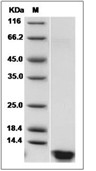 |
| Endotoxin | Please contact us for more information. |
| Formulation | Lyophilized from a solution filtered through a 0.22 μm filter, containing PBS, pH 7.4. Typically, a mixture containing 5% to 8% trehalose, mannitol, and 0.01% Tween 80 is incorporated as a protective agent before lyophilization. |
| Reconstitution | Reconstituted with sterile deionized water to 0.13 mg/mL. Reconstitution conditions may vary depending on the lot. |
| Synonyms | MODY10, IRDN, insulin, INS, ILPR, IDDM2, IDDM1, IDDM |
| Research Background | INS (Insulin) is a Protein Coding gene. This gene encodes insulin, a peptide hormone that plays a vital role in the regulation of carbohydrate and lipid metabolism. After removal of the precursor signal peptide, proinsulin is post-translationally cleaved into three peptides: the B chain and A chain peptides, which are covalently linked via two disulfide bonds to form insulin, and C-peptide. The binding of insulin to the insulin receptor (INSR) stimulates glucose uptake. Diseases associated with INS include Hyperproinsulinemia and Maturity-Onset Diabetes Of The Young, Type 10. A multitude of mutant alleles with phenotypic effects has been identified, including insulin-dependent diabetes mellitus, permanent neonatal diabetes mellitus, maturity-onset diabetes of the young type 10, and hyperproinsulinemia. |
| Molecular Weight | 7.1 kDa (predicted); 6 kDa (reducing conditions) |
| Shipping | In general, lyophilized powders are shipped with blue ice, while solutions are shipped with dry ice. |
| Storage | It is recommended to store recombinant proteins at -20°C to -80°C for future use. Lyophilized powders can be stably stored for over 12 months, while liquid products can be stored for 6-12 months at -80°C. For reconstituted protein solutions, the solution can be stored at -20°C to -80°C for at least 3 months. Please avoid multiple freeze-thaw cycles and store products in aliquots. |
Calculator
Dose Conversion
Keywords
MODY-10MODY 10IDDM-2IDDM-1IDDM 2IDDM 1
Preview
Related Tags: Insulin Protein, Human, Recombinant chemical structure | Insulin Protein, Human, Recombinant molecular weight
Generate Quote
Catalog No.: Cas No.:
Add
| Size | Quantity | Unit Price | Amount | Operation |
|---|
Generate Quote