

Hydrogen Peroxide Fluorescent Detection Kit

Referência OKAU00031
Tamanho : 2plate
Marca : Aviva Systems Biology
Contactar o distribuidor local :
 Telefone : +1 850 650 7790
Hydrogen Peroxide Fluorescent Detection Kit (OKAU00031)
| Datasheets/Manuals | Printable datasheet for Hydrogen Peroxide Fluorescent Detection Kit (OKAU00031) |
|---|
| Application | ELISA-Sandwich | ||||||||||||||||||||||||||||||
|---|---|---|---|---|---|---|---|---|---|---|---|---|---|---|---|---|---|---|---|---|---|---|---|---|---|---|---|---|---|---|---|
| ELISA Kit Detection Method | Fluorometric | ||||||||||||||||||||||||||||||
| ELISA Kit Linearity | Linearity was determined by taking two RPMI-1640 media samples with known H2O2 concentrations and mixing them in the ratios given below. The measured concentrations were compared to the expected values based on the ratios used.
| ||||||||||||||||||||||||||||||
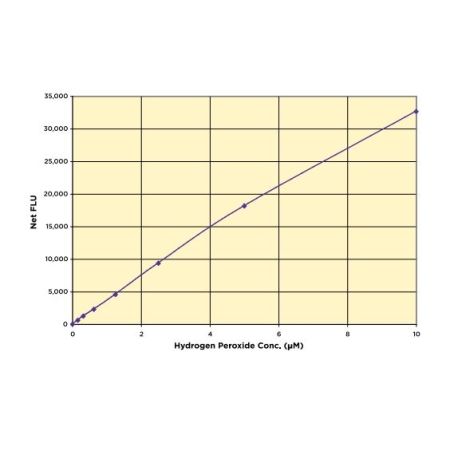
| ELISA Kit Principle | The DetectX® Hydrogen Peroxide Fluorescent Detection Kit is designed to quantitatively measure H2O2 in a variety of samples. Please read the complete kit insert before performing this assay. A hydrogen peroxide standard is provided to generate a standard curve for the assay and all samples should be read off the standard curve. Samples are mixed with the Substrate and the reaction initiated by addition of horseradish peroxidase. The reaction is incubated at room temperature for 15 minutes. The HRP reacts with the substrate in the presence of hydrogen peroxide to convert the colorless substrate into a fluorescent product. The fluorescent product is read at 590 nm with excitation at 570 nm. Increasing levels of H2O2 cause a linear increase in fluorescent product. | ||||||||||||||||||||||||||||||
| ELISA Kit Reproducibility | Intra Assay Precision Three buffer samples were run in replicates of 20 in an assay. The mean and precision of the calculated concentrations were:
| ||||||||||||||||||||||||||||||
| ELISA Kit Component |
| ||||||||||||||||||||||||||||||
| Additional Information | Background: Hydrogen peroxide was first described in 1818 by Louis Jacques Thénard. Today, industrially, hydrogen peroxide is manufactured almost exclusively by the autoxidation of a 2-alkyl-9,10- dihydroxyanthracene to the corresponding 2-alkyl anthraquinone in the Riedl-Pfleiderer or anthraquinone process. In biological systems incomplete reduction of O2 during respiration produces superoxide anion (O2), which is spontaneously or enzymatically dismutated by superoxide dismutase to H2O2. Many cells produce low levels of O2 and H2O2 in response to a variety of extracellular stimuli, such as cytokines (TGF-s1, TNF-a, and various interleukins), peptide growth factors (PDGF; EGF, VEGF, bFGF, and insulin), the agonists of heterotrimeric G protein-coupled receptors (GPCR) such as angiotensin II, thrombin, lysophosphatidic acid, sphingosine 1-phosphate, histamine, and bradykinin, and by shear stress. The addition of exogenous H2O2 or the intracellular production in response to receptor stimulation affects the function of various proteins, including protein kinases, protein phosphatases, transcription factors, phospholipases, ion channels, and G proteins. In 1894, Fenton2 described the oxidation of tartaric acid by Fe2+ and H2O2. H2O2 and O2 may participate in the production of singlet oxygen and peroxynitrite and the generation of these species may be concurrent with reactions involving iron, and under some circumstances they might be important contributors to H2O2 toxicity. A substantial portion of H2O2 lethality involves DNA damage by oxidants generated from ironmediated Fenton reactions. Damage by Fenton oxidants occurs at the DNA bases or at the sugar residues. Sugar damage is initiated by hydrogen abstraction from one of the deoxyribose carbons, and the predominant consequence is eventual strand breakage and base release. | ||||||||||||||||||||||||||||||
| :: | Detection Limit: The Limit of Detection was determined as 0.052 uM. This is equivalent to 2.6 pmol (88.4 pg) H2O2 per well. | ||||||||||||||||||||||||||||||
| Reconstitution and Storage | 2°C to 8°C | ||||||||||||||||||||||||||||||
| Sample Type | Fresh Urine, Buffers and TCM | ||||||||||||||||||||||||||||||
| Sensitivity | Sensitivity was determined as 0.038 uM. This is equivalent to 1.9 pmol (64.6 pg) H2O2 per well. |
| Gene Full Name | Hydrogen Peroxide |
|---|