
Human STAT6 Antibody : APC (Phospho-Tyr641)

Referência OAAQ00017-100tests
Tamanho : 100Tests
Marca : Aviva Systems Biology
Contactar o distribuidor local :
 Telefone : +1 850 650 7790
Human STAT6 Antibody : APC (Phospho-Tyr641)
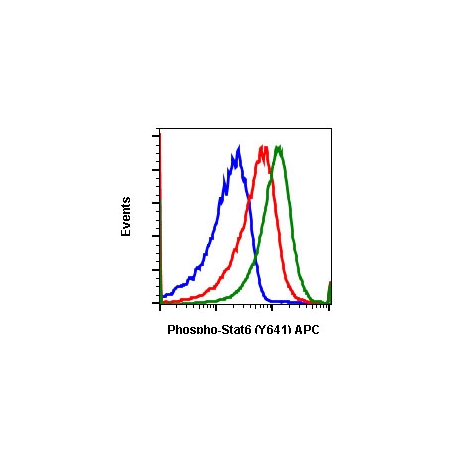
Human STAT6 Antibody : APC (Phospho-Tyr641) (OAAQ00017)
| Datasheets/Manuals | Printable datasheet for OAAQ00017 |
|---|
| Tested Species Reactivity | Human, Mouse |
|---|---|
| Predicted Species Reactivity | Mouse, Rat |
| Product Format | Liquid. 1X PBS, 0.09% NaN3, 0.2% BSA. |
| Clonality | Monoclonal |
| Clone | Stat6Y641-G12 |
| Isotype | Rabbit IgG1k |
| Host | Rabbit |
| Conjugation | APC: Allophycocyanin |
| Application | FC |
| Reconstitution and Storage | 2-8C |
| Immunogen | A synthetic phospho-peptide corresponding to residues surrounding Tyr641 of human phospho Stat6 |
| Purification | Protein A+G |
| Target Post-Translational Modification | Phospho-Tyr641 |
| Application Info | For flow cytometric staining, the suggested use of this reagent is 5 uL per million cells or 5 uL per 100 uL of staining volume. It is recommended that the reagent be titrated for optimal performance for each application. |
| Reference | Kaplan MH, Schindler U, Smiley ST, and Grusby MJ. (1996) Immunity. 4:313-319. Demicco EG, Harms PW, Patel RM, et al. (2015) American Journal of Clinical Pathology. 143:672-682. Wick KR, and Berton MT. (2000) Molecular Immunology. 37:641-652. |
|---|---|
| Gene Symbol | STAT6 |
| Gene Full Name | signal transducer and activator of transcription 6 |
| Alias Symbols | STAT6B, STAT6C, D12S1644, IL-4-STAT |
| NCBI Gene Id | 6778 |
| Protein Name | signal transducer and activator of transcription 6 |
| Description of Target | The protein encoded by this gene is a member of the STAT family of transcription factors. In response to cytokines and growth factors, STAT family members are phosphorylated by the receptor associated kinases, and then form homo- or heterodimers that translocate to the cell nucleus where they act as transcription activators. This protein plays a central role in exerting IL4 mediated biological responses. It is found to induce the expression of BCL2L1/BCL-X(L), which is responsible for the anti-apoptotic activity of IL4. Knockout studies in mice suggested the roles of this gene in differentiation of T helper 2 (Th2) cells, expression of cell surface markers, and class switch of immunoglobulins. Alternative splicing results in multiple transcript variants. |
| Uniprot ID | P42226 |
| Protein Accession # | NP_001171549.1 |
| Nucleotide Accession # | NM_001178078.1 |