


- A micro ELISA plate ---The 96-well plate has been pre-coated with an anti-human DCD antibody. This dismountable microplate can be divided into 12 x 8 strip plates.
- Two vials lyophilized standard ---Dilute a bottle of the standard at dilution series, read the OD values, and then draw a standard curve.
- One vial Biotin-labeled DCD antibody (100 x concentrate) (120 μl/bottle) ---Act as the detection antibody.
- One vial HRP-avidin (100 x concentrate) (120 μl/bottle) ---Bind to the detection antibody and react with the TMB substrate to make the solution chromogenic.
- One vial Biotin-antibody Diluent (15 ml/bottle) ---Dilute the Biotin-antibody.
- One vial HRP-avidin Diluent (15 ml/bottle) ---Dilute the HRP-avidin solution.
Human Proteolysis Inducing Factor/Dermcidin(PIF/DCD)ELISA Kit
Referência CSB-E13626h-96T
Tamanho : 96T
Marca : Cusabio
Contactar o distribuidor local :

Telefone : +1 850 650 7790
 SDS
| Size | 96T,5×96T,10×96T |
Product Details
Target Name
dermcidin
Associated names
AIDD ELISA Kit; DCD 1 ELISA Kit; dcd ELISA Kit; DCD-1 ELISA Kit; DCD_HUMAN ELISA Kit; Dermcidin ELISA Kit; DSEP ELISA Kit; HCAP ELISA Kit; PIF ELISA Kit; Preproteolysin ELISA Kit
Abbreviation
DCD
Uniprot No.
Species
Homo sapiens (Human)
Sample Types
serum, plasma, cell culture supernates, urine, tissue homogenates
Detection Range
0.625 ng/mL-40 ng/mL
Sensitivity
0.156 ng/mL
Assay Time
1-5h
Sample Loading Volume
50-100ul
Detection Wavelength
450 nm
Research Area
Cell Biology
Assay Principle
quantitative
Measurement
Sandwich
Precision
| Intra-assay Precision (Precision within an assay): CV%<8% | ||||||
| Three samples of known concentration were tested twenty times on one plate to assess. | ||||||
| Inter-assay Precision (Precision between assays): CV%<10% | ||||||
| Three samples of known concentration were tested in twenty assays to assess. | ||||||
Linearity
| To assess the linearity of the assay, samples were spiked with high concentrations of human PIF/DCD in various matrices and diluted with the Sample Diluent to produce samples with values within the dynamic range of the assay. | ||||||
| Sample | Serum(n=4) | |||||
| 1:100 | Average % | 84 | ||||
| Range % | 80-92 | |||||
| 1:200 | Average % | 97 | ||||
| Range % | 91-105 | |||||
| 1:400 | Average % | 97 | ||||
| Range % | 92-110 | |||||
| 1:800 | Average % | 93 | ||||
| Range % | 86-98 | |||||
Recovery
| The recovery of human PIF/DCD spiked to levels throughout the range of the assay in various matrices was evaluated. Samples were diluted prior to assay as directed in the Sample Preparation section. | ||||||
| Sample Type | Average % Recovery | Range | ||||
| Serum (n=5) | 95 | 89-98 | ||||
| EDTA plasma (n=4) | 97 | 90-107 | ||||
Typical Data
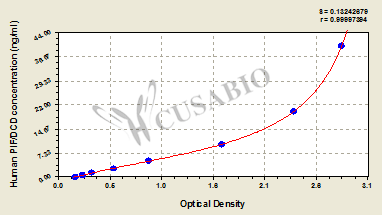
| These standard curves are provided for demonstration only. A standard curve should be generated for each set of samples assayed. | |||||||||||||||||||||||||||||||||||||||||||||||||||||||||||||||
| |||||||||||||||||||||||||||||||||||||||||||||||||||||||||||||||
Materials provided
Materials not provided
- A microplate reader capable of measuring absorbance at 450 nm, with the correction wavelength set at 540 nm or 570 nm.
- An incubator can provide stable incubation conditions up to 37°C±5°C.
- Centrifuge
- Vortex
- Squirt bottle, manifold dispenser, or automated microplate washer
- Absorbent paper for blotting the microtiter plate
ELISA Data Analysis
Troubleshooting
and FAQs
and FAQs
Storage
Store at 2-8°C. Please refer to protocol.
Shelf Life
6 months
Description
This Human DCD ELISA Kit was designed for the quantitative measurement of Human DCD protein in serum, plasma, cell culture supernates, urine, tissue homogenates. It is a Sandwich ELISA kit, its detection range is 0.625 ng/mL-40 ng/mL and the sensitivity is 0.156 ng/mL .
Citations
- AI Álvarez-Mercado, B López-Plaza, J Plaza-Diaz,Pharmaceuticals,2025
- AI Alvarez,medRxiv,2024
- Ortega-Martnez I.et al,Int J Cancer.,2016
Customer Reviews and Q&A
There are currently no reviews for this product.
■ Q&A
Q:
I am interested in buying a ELISA Kit for Human Dermcidin (DCD) but I need to detect this protein in Saliva Samples.,
Do you have any information about if the kit that you offer have been ever tested with saliva samples?
A:
Thanks for your inquiry.
We use this kit to detect human saliva sample with 1:10 dilution and get the value is 2.5--10ng/ml, then the final concentration is 25--100ng/ml.Pls let me know if you have any further questions. Thank you.
We use this kit to detect human saliva sample with 1:10 dilution and get the value is 2.5--10ng/ml, then the final concentration is 25--100ng/ml.Pls let me know if you have any further questions. Thank you.
Target Background
Function
(From Uniprot)
(From Uniprot)
DCD-1 displays antimicrobial activity thereby limiting skin infection by potential pathogens in the first few hours after bacterial colonization. Highly effective against E.coli, E.faecalis, S.aureus and C.albicans. Optimal pH and salt concentration resemble the conditions in sweat. Also exhibits proteolytic activity, cleaving on the C-terminal side of Arg and, to a lesser extent, Lys residues.; Survival-promoting peptide promotes survival of neurons and displays phosphatase activity. It may bind IgG.
Gene References into Functions
- the present study suggests that dermcidin is a novel binding protein of lncRNA STCAT3, which serves an important role in the progress and clinical outcome of gastric cancer
- The results of this study suggest that these biomarker DCD can serve as a potential non-invasive early diagnosis platform reflecting PiB-PET imaging for Mild Cognitive Impairment and Alzheimer's Disease.
- this study shows that PIF regulates systemic immunity and targets protective regulatory and cytoskeleton proteins
- This is the first report of the presence of DCD in nasal mucosa and demonstration of DCD in clinical samples of human nasal secretions at clinically relevant concentrations, which may represent a novel arm of sinonasal airway innate defense.
- Identification of dermcidin in human sebaceous gland cells supports the concept that sebocytes play an important role in the innate immunity of the skin through the expression of antimicrobial peptides and specific lipids.
- Reduced DCD concentration in sweat in patients with inflammatory acne may permit proliferation of P. acnes in pilosebaceous units, resulting in progression of inflammatory acne.
- These findings imply that DCD promotes breast tumorigenesis via modulation of ERBB signaling pathways
- Dermcidin binds platelets and may inhibit the therapeutic action of aspirin following acute myocardial infarction.
- Data indicate that Y-P30/dermcidin expressed in placentas of first trimester pregnancies.
- Increased Dermcidin was also detected with immunoblotting.
- Crystal structure and functional mechanism of a human antimicrobial membrane channel
- major binding partners of LEKTI were found to be the antimicrobial peptide dermcidin and the serine protease cathepsin G and no kallikreins.
- Structure-activity analysis of the dermcidin-derived peptide DCD-1L, an anionic antimicrobial peptide present in human sweat.
- revealed that Nck1 SH2 domain binds to the phosphotyrosine residue at position 20 (Y20) of the DCD
- dermcidin was a novel platelet aggregating agent, and potentiated the ADP induced thrombosis in the animal model as well as acutely inhibited glucose induced insulin synthesis.
- There was a significant correlation between weight loss and survival in the PIF-positive non-small-cell lung cancer patients.
- Data show that dermcidin adopts a flexible amphipathic alpha-helical structure with a helix-hinge-helix motif, which is a common molecular fold among antimicrobial peptides.
- identified as antibiotic peptide secreted by sweat glands
- Our results confirmed previous findings indicating that dermcidin-1L could have promising therapeutic potentials and shed new light on the structure-function relationship of dermcidin-1L.
- Reduced expression of dermcidin in sweat of patients with atopic dermatitis may contribute to the high susceptibility of these patients to skin infections and altered skin colonization with Staphylococcus aureus.
- NF-kappaB and STAT3 are activated by proteolysis inducing factor in human Kupffer cells and monocytes
- Functional analysis indicated that proteolytic processing of DCD-1L by Cathepsin D in human sweat modulates the innate immune defense of human skin.
- Dermcidin may function as an oncogene in hepatic as well as breast cells; Glycosylation is not required, but the importance of asparagine residues suggests a role for the proteolysis-inducing factor core peptide domain.
- This work suggests that DCD might participate in the regulation of placental function by means of modulating the proteolytic cascades on the trophoblastic cell surface.
- Dermcidin is a proliferation and survival factor in prostate cancer cells subjected to stressors found in the prostate cancer microenvironment.
- These data suggest that the disorder and order transition may be relevant for some biological functions of PIF/DCD.
- There is a growing body of evidence illustrating dermcidin as an oncogene and its Y-P30 subunite as a survival factor (Review)
- Expression of dermcidin in human primary tumours appears highly variable and is not induced substantially by hypoxia/oxidative stress in cell line model systems
- pleiotrophin (PTN) and syndecan-2 and -3 as direct binding partners of Y-P30.
- IRAK-4, which is essential for virtually all TLR signalling, was suppressed, whereas the precursor for the antibiotic peptide Dermcidin was up-regulated in HIV-infected cells.
Subcellular Location
Secreted.
Tissue Specificity
Specifically and constitutively expressed in eccrine sweat gland cells. Secreted into the sweat at a concentration of 1-10 micrograms/ml.
Database Links
HGNC:
OMIM:
KEGG:
UniGene: