

HotBegan™ Hot Start Taq-DNA Polymerase

Referência P0028
Tamanho : 500U
Marca : Canvax Biotech
Contactar o distribuidor local :
 Telefone : +1 850 650 7790
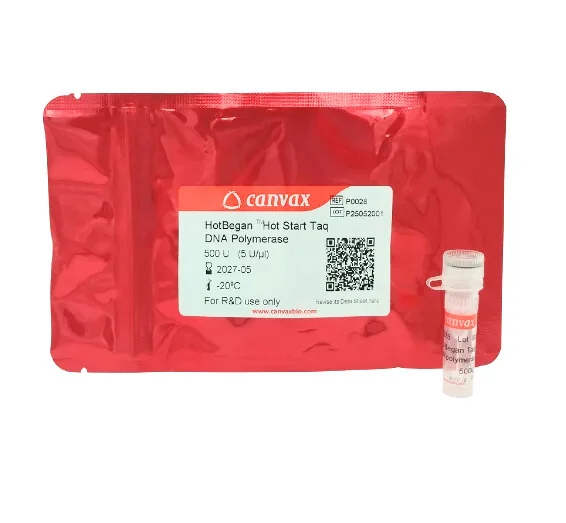
HotBegan™ Hot Start Taq-DNA Polymerase
High-specificity hot-start Taq polymerase for clean, reproducible PCR amplification.
HotBegan™ Hot-Start Taq DNA Polymerase is a thermostable DNA polymerase chemically modified to prevent non-specific amplification before thermal activation. This optimized formulation ensures exceptional specificity, sensitivity, and reproducibility in PCR reactions, making it ideal for applications requiring accurate amplification from complex templates.
Upon initial denaturation, the enzyme becomes fully active, delivering robust yields with minimal background. It is suitable for high-throughput PCR, multiplex assays, and diagnostic research workflows, ensuring consistent results even in challenging amplification conditions.
Have questions? Contact us
Detailed information:
Advantages & Features
-
Hot-start activation: Prevents non-specific amplification and primer–dimer formation.
-
High specificity: Produces clean and accurate PCR products from complex templates.
-
Thermostable formulation: Maintains activity after repeated heating cycles.
-
Consistent performance: Reproducible results across a wide range of samples.
-
Versatile compatibility: Suitable for genomic, plasmid, and cDNA templates.
-
Reduced background: Enhanced reaction clarity and band definition.
Specifications
| Parameter | Specification |
|---|---|
| Enzyme type | Chemically modified hot-start Taq DNA Polymerase |
| Activity | 5 U/µL |
| Fidelity | Standard (no proofreading) |
| Fragment length | Up to 5 kb |
| Activation temperature | 95 °C |
| DNase/RNase contamination | None detected |
| Unit definition | One unit is defined as the amount of enzyme required to catalyse the incorporation of 10 nanomoles of dNTPs into acid-insoluble material in 30 minutes at 74°C. |
Includes
– 100 μL HotBegan™ Hot Start Taq DNA Polymerase (5 U/μL)
– 25 mM MgCl2 (1.5 mL)
– 1.5 mL Buffer (10x)
Download documentation
Applications
-
High-specificity PCR amplification.
-
Multiplex and diagnostic PCR assays.
-
Low-copy target amplification.
-
qPCR and endpoint PCR applications.
-
Routine PCR with complex DNA templates.
Tables & Figures
t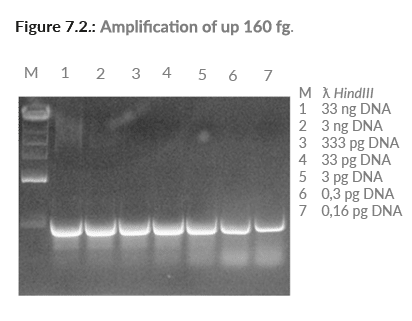
Quality Control
- Each batch is tested for specificity, thermostability, fidelity, and absence of DNase/RNase contamination, ensuring reproducible high-quality PCR results.
Advice
-
Include an initial 95 °C activation step (2–10 min) before cycling.
-
Use optimized annealing temperatures for complex templates.
-
Store aliquots to avoid repeated freeze–thaw cycles.
Storage & Shipping
- Shipped in: Gel pack.
- Storage: -20 °C.
Citations
- Mora-Sala, B., León, M., Pérez-Sierra, A., & Abad-Campos, P. (2022). New Reports of Phytophthora Species in Plant Nurseries in Spain. Pathogens, 11(8), 826.
- Aigoun-Mouhous, Wassila, et al. “Cadophora sabaouae sp. nov. and Phaeoacremonium species associated with Petri disease on grapevine propagation material and young grapevines in Algeria.” Plant Disease ja (2021).
- León, Maela, et al. “Identification and Characterization of Diaporthe spp. Associated with Twig Cankers and Shoot Blight of Almonds in Spain.“ Agronomy 10.8 (2020): 1062.
- Albuquerque, C. A. D. (2019). Detection and characterization of Dichelobacter nodosus from sheep with different clinical manifestations of Ovine Footrot (Doctoral dissertation).
- Roque, J. M. L. (2019). Mecanismos virucidas da irradiação por feixe de eletrões em adenovírus humanos (Doctoral dissertation).
- Elena, G., Berbegal, M., González-Domínguez, E., & Armengol, J. (2019). Identification of inoculum sources of Fusicladium eriobotryae in loquat orchards in Spain. European Journal of Plant Pathology, 1-12.
- Osset Iborra, H. (2019). Seguimiento de las plagas de Tomicus destruens y Orthotomicus erosus y detección de Botryosphaeriaceae, hongos patógenos asociados a estos insectos, en los pinares de Pinus halepensis de La Pedrera y la Devesa del Saler (Valencia) (Doctoral dissertation).
- Olmo, D., Armengol, J., León, M., & Gramaje, D. (2016). Characterization and pathogenicity of Botryosphaeriaceae species isolated from almond trees on the island of Mallorca (Spain). Plant disease, 100(12), 2483-2491.
- Negreiros, A. M., Júnior, R. S., Rodrigues, A. P., León, M., & Armengol, J. Prevalent weeds collected from cucurbit fields in Northeastern Brazil reveal new species diversity in the genus Monosporascus. Annals of Applied Biology.
- Martín-Pinto, P. Fungal communities from forest systems in Ethiopia.
- Dejene, T., Oria-de-Rueda, J. A., & Martín-Pinto, P. (2017). Fungal diversity and succession under Eucalyptus grandis plantations in Ethiopia. Forest Ecology and Management, 405, 179-187.
- Dejene, T., Oria-de-Rueda, J. A., & Martín-Pinto, P. (2017). Fungal diversity and succession following stand development in Pinus patula Schiede ex Schltdl. & Cham. plantations in Ethiopia. Forest Ecology and Management, 395, 9-18.
- Huyghe, J. (2017). Selection of reference genes for gene expression studies in Lactic acid bacteria.
- Dejene, T., Oria-de-Rueda, J. A., & Martín-Pinto, P. (2017). Fungal community succession and sporocarp production following fire occurrence in Dry Afromontane forests of Ethiopia. Forest Ecology and Management, 398, 37-47.
- Criado-García, J., Fuentes, F., Cruz-Teno, C., García-Rios, A., Jiménez-Morales, A., Delgado-Lista, J., … & Pérez-Jiménez, F. (2011). R353Q polymorphism in the factor VII gene and cardiovascular risk in Heterozygous Familial Hypercholesterolemia: a case-control study. Lipids in health and disease, 10(1), 50.
- Català, S., Pérez-Sierra, A., & Abad-Campos, P. (2015). The use of genus-specific amplicon pyrosequencing to assess Phytophthora species diversity using eDNA from soil and water in northern Spain. PloS one, 10(3), e0119311.
- Olmo, D., Armengol, J., León, M., & Gramaje, D. (2016). Characterization and Pathogenicity of Botryosphaeriaceae Species Isolated from Almond Trees on the Island of Mallorca (Spain). Plant Disease, 100(12), 2483-2491.
- Dejene, T., Oria-de-Rueda, J. A., & Martín-Pinto, P. (2017). Fungal diversity and succession following stand development in Pinus patula Schiede ex Schltdl. & Cham. plantations in Ethiopia. Forest Ecology and Management, 395, 9-18.
Safety Statements
This product is developed, designed and sold exclusively for Research purposes and in vitro use only (RUO). The product was not tested for use in diagnostics or for drug development, nor is it suitable for administration to humans or animals. For more info, please check its Material Safety Data Sheet available in this website.
Customers Review
Synonym(s)
Hot start Taq DNA polymerase, Taq polymerase hot start enzyme, PCR enzyme hot start, DNA amplification enzyme hot start, Thermostable hot start polymerase
Also known as:
- Spanish: ADN polimerasa Taq hot start, Polimerasa termoestable hot start, Enzima PCR hot start
- French: ADN polymérase Taq hot start, Polymérase thermostable hot start, Enzyme PCR hot start
- German: Taq-DNA-Polymerase Hot-Start, Thermostabile Polymerase Hot-Start, PCR-Enzym Hot-Start
- Italian: DNA polimerasi Taq hot start, Polimerasi termostabile hot start, Enzima PCR hot start
FAQs
Q1: What is the activation temperature for HotBegan™ Hot-Start Taq?
The enzyme activates fully at 95 °C during the initial denaturation step.
Q2: Can it be used for multiplex PCR?
Yes. It provides excellent performance and specificity in multiplex assays.
Q3: Does the enzyme require special buffers?
No. It comes with an optimized reaction buffer suitable for most PCR applications.