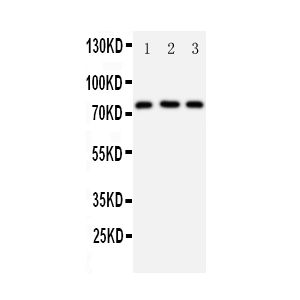
DDX4 Antibody - Biotin

Referência OABF01275-Biotin
Tamanho : 100ul
Marca : Aviva Systems Biology
Contactar o distribuidor local :

Telefone : +1 850 650 7790
DDX4 Antibody : Biotin (OABF01275-Biotin)

Click here to learn more about Aviva's By-Request Conjugation Service.
| Datasheets/Manuals | Printable datasheet for OABF01275-Biotin |
|---|
| Predicted Species Reactivity | Human, Mouse, Rat, Chicken |
|---|---|
| Product Format | Liquid. Purified antibody supplied in 1x PBS buffer. |
| Clonality | Polyclonal |
| Isotype | IgG |
| Host | Rabbit |
| Conjugation | Biotin |
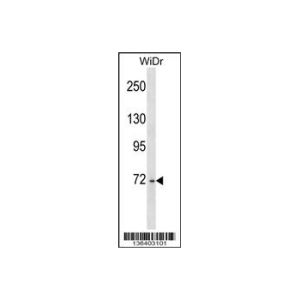
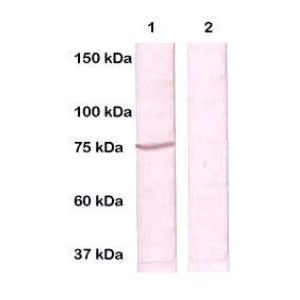
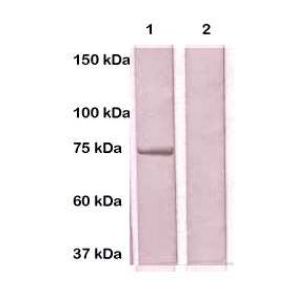
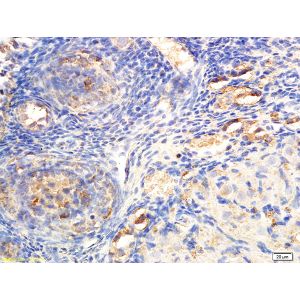
| Application | WB, FC, IHC-P, IF |
| Additional Information | Subcellular location: Cytoplasm |
| Reconstitution and Storage | All conjugated antibodies should be stored in light-protected vials or covered with a light protecting material (i.e. aluminum foil). Conjugated antibodies are stable for at least 12 months at 4C. If longer storage is desired (24 months), conjugates may be diluted with up to 50% glycerol and stored at -20C to -80C. Freezing and thawing conjugated antibodies will compromise enzyme activity as well as antibody binding. |
| Immunogen | KLH conjugated synthetic peptide derived from human DDX4 |
| Purification | Purified by Protein A. |
| Concentration | 1 mg/ml |
| Application Info | WB(1:100-1000) FC(1:20-100) IHC-P(1:100-500) IF(1:50-200) |
| Gene Symbol | DDX4 |
|---|---|
| Gene Full Name | DEAD (Asp-Glu-Ala-Asp) box polypeptide 4 |
| Alias Symbols | VASA |
| NCBI Gene Id | 54514 |
| Description of Target | Summary: DEAD box proteins, characterized by the conserved motif Asp-Glu-Ala-Asp (DEAD), are putative RNA helicases. They are implicated in a number of cellular processes involving alteration of RNA secondary structure such as translation initiation, nuclear and mitochondrial splicing, and ribosome and spliceosome assembly. Based on their distribution patterns, some members of this family are believed to be involved in embryogenesis, spermatogenesis, and cellular growth and division. This gene encodes a DEAD box protein, which is a homolog of VASA proteins in Drosophila and several other species. The gene is specifically expressed in the germ cell lineage in both sexes and functions in germ cell development. Multiple transcript variants encoding different isoforms have been found for this gene. [provided by RefSeq]. |
| Uniprot ID | Q9NQI0 |