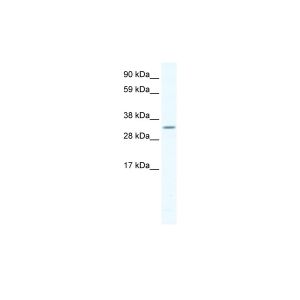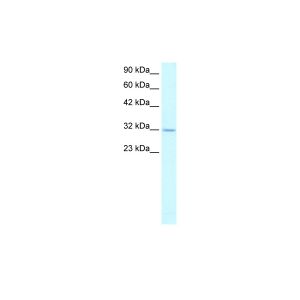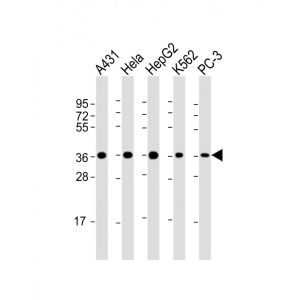

APEX1 antibody - N-terminal region

Referência ARP37014_T100
Tamanho : 100ul
Marca : Aviva Systems Biology
Contactar o distribuidor local :
 Telefone : +1 850 650 7790
APEX1 Antibody - N-terminal region (ARP37014_T100)
| Datasheets/Manuals | Printable datasheet for anti-APEX1 (ARP37014_T100) antibody |
|---|
| Tested Species Reactivity | Mouse |
|---|---|
| Predicted Species Reactivity | Human, Mouse, Rat, Cow, Dog, Goat, Guinea Pig, Horse, Pig, Rabbit |
| Product Format | Liquid. Purified antibody supplied in 1x PBS buffer with 0.09% (w/v) sodium azide and 2% sucrose. |
| Clonality | Polyclonal |
| Host | Rabbit |
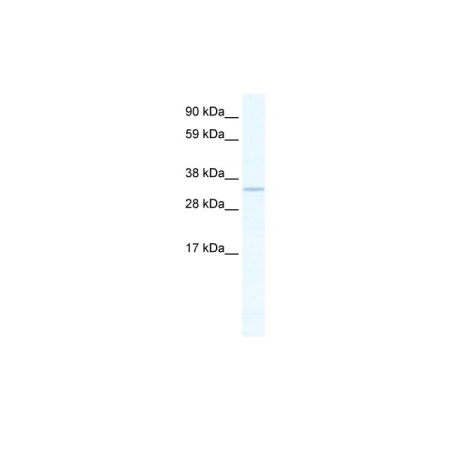
| Application | WB |
| Reconstitution and Storage | For short term use, store at 2-8C up to 1 week. For long term storage, store at -20C in small aliquots to prevent freeze-thaw cycles. |
| Immunogen | The immunogen is a synthetic peptide directed towards the N terminal region of mouse APEX1 |
| Purification | Protein A purified |
| Predicted Homology Based on Immunogen Sequence | Cow: 100%; Dog: 93%; Goat: 93%; Guinea Pig: 93%; Horse: 100%; Human: 100%; Mouse: 100%; Pig: 100%; Rabbit: 100%; Rat: 93% |
| Peptide Sequence | Synthetic peptide located within the following region: ETKKSKGAAKKTEKEAAGEGPVLYEDPPDQKTSPSGKSATLKICSWNVDG |
| Concentration | 1.0 mg/ml |
| Blocking Peptide | For anti-APEX1 (ARP37014_T100) antibody is Catalog # AAP37014 (Previous Catalog # AAPP09925) |
| Reference | Izumi,T., et al., (2005) Proc. Natl. Acad. Sci. U.S.A. 102 (16), 5739-5743 |
|---|---|
| Gene Symbol | APEX1 |
| Gene Full Name | Apurinic/apyrimidinic endonuclease 1 |
| Alias Symbols | HA, APE, Apex, HAP1, Ref-, Ref-1 |
| NCBI Gene Id | 11792 |
| Protein Name | Apurinic/apyrimidinic endonuclease 1 EMBL EDL20835.1 |
| Description of Target | Apurinic/apyrimidinic (AP) sites occur frequently in DNA molecules by spontaneous hydrolysis, by DNA damaging agents or by DNA glycosylases that remove specific abnormal bases. AP sites are pre-mutagenic lesions that can prevent normal DNA replication so the cell contains systems to identify and repair such sites. Class II AP endonucleases cleave the phosphodiester backbone 5' to the AP site. This gene encodes the major AP endonuclease in human cells. |
| Uniprot ID | Q544Z7 |
| Protein Accession # | NP_033817 |
| Nucleotide Accession # | NM_009687 |
| Protein Size (# AA) | 317 |
| Molecular Weight | 35kDa |
| Protein Interactions | Pcna; Gadd45a; Eed; Mutyh; Plcb1; Hdac1; Sin3a; Hdac2; |