


Inquiry
Dispatch Time: About 3 working days
- Product Name
- APC Anti-Mouse CD6 Antibody(OX-129)
- Catalogue No.
- APC-30266
- Form
- liquid
- Conjugation
- APC
- Conjugation Information
- APC is designed to be excited by the Red (627-640 nm) laser and detected using an optical filter centered near 660 nm (e.g., a 660/20 nm bandpass filter).
- Clonality
- Monoclonal
- Isotype
- IgG2a, κ
- Clone ID
- OX-129
- Storage
- PBS with 0. 1% sodium azide, 1%BSA, pH 7.3, 2-8℃ for 12 months (Avoid repeated freeze / thaw cycles.)
Immunogen
- Alternative Names
- CD6|TP120 antibody
- UniProt ID
- Q61003
Application
- Tested Applications
- FC
- Recommended dilution
- Volume per test: 5μL. Each lot of this antibody is quality control tested by flow cytometric analysis. The amount of the reagent is suggested to be used 5 µL of antibody per test (million cells in 100 µL staining volume or per 100 µL of whole blood). Please check your vial before the experiment. Since applications vary, the appropriate dilutions must be determined for individual use.
Validated Images
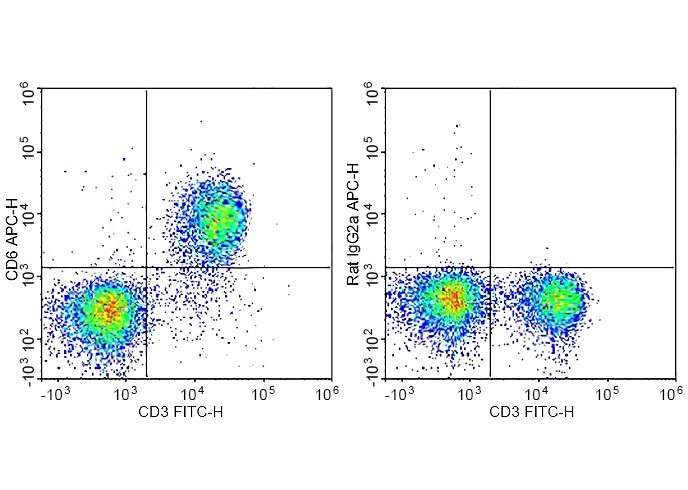 Staining of C57BL/6 murine splenocytes cells with FITC Anti-Mouse CD3 Antibody and APC Anti-Mouse CD6 Antibody(OX-129) (left) or APC Rat IgG2a, κ Isotype Control (right). Total viable cells were used for analysis.
- Background
- CD6, a 100 kD monomeric T cell surface glycoprotein, is a member of the scavenger receptor cysteine-rich protein superfamily. It is expressed on mouse thymocytes and splenic T cells and neurons, but not on splenic B cells. CD6 has a long cytoplasmic tail in mice, with two proline-rich domains that interact with the -SH3 domain binding sequence. CD6 binding to its ligand, CD166 (ALCAM), serves as a costimulatory molecule through its interaction with SLP-76. CD6 mediated signaling may contribute to thymocyte survival and functional avidity in mice and men.