


Inquiry
Dispatch Time: About 3 working days
- Product Name
- APC Anti-Human CD99 Antibody(HI156)
- Catalogue No.
- APC-30206
- Form
- liquid
- Conjugation
- APC
- Conjugation Information
- APC is designed to be excited by the Red (627-640 nm) laser and detected using an optical filter centered near 660 nm (e.g., a 660/20 nm bandpass filter).
- Clonality
- Monoclonal
- Isotype
- IgG2a, κ
- Clone ID
- HI156
- Storage
- PBS with 0. 1% sodium azide, 1%BSA, pH 7.3, 2-8℃ for 12 months (Avoid repeated freeze / thaw cycles.)
Immunogen
- Alternative Names
- E2 antigenHBA71MIC2MSK5X|CD99 antibody
- UniProt ID
- P14209
Application
- Tested Applications
- FC
- Recommended dilution
- Volume per test: 5μL. Each lot of this antibody is quality control tested by flow cytometric analysis. The amount of the reagent is suggested to be used 5 µL of antibody per test (million cells in 100 µL staining volume or per 100 µL of whole blood). Please check your vial before the experiment. Since applications vary, the appropriate dilutions must be determined for individual use.
Validated Images
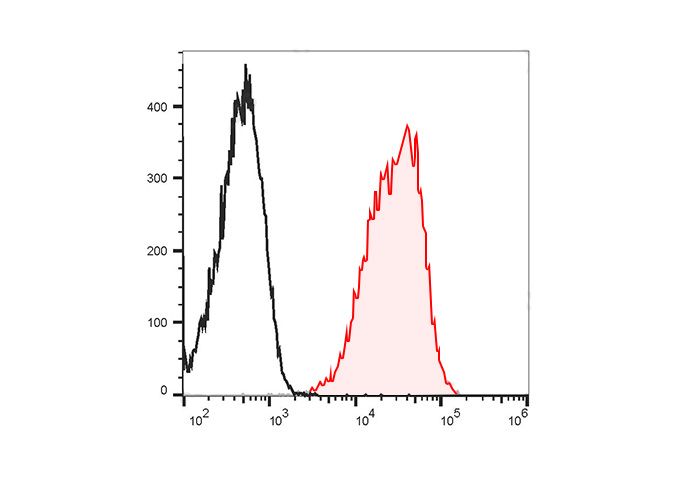 Human peripheral blood lymphocytes are stained with APC Anti-Human CD99 Antibody(HI156) (filled gray histogram) or APC Mouse IgG2a, κ Isotype Control (black histogram).
 - Background
- CD99 is a type I single chain transmembrane protein devoid of N-linked glycosylation sites encoded by the pseudoautosomal gene MIC2. CD99 has an apparent molecular weight of 32 kD and is widely expressed on a variety of tissues. CD99 is highly expressed on thymocytes, T cells, and T cell leukemias and lymphomas. However, it is absent on some B cell lines, fetal B cells, eosinophils, granulocytes and the NK-cell line YT. CD99 is involved in spontaneous rosette formation with erythrocytes and may also be involved in other T-cell and hematopoietic cell adhesion pathways. CD99 has been reported to activate a caspase-independent death pathway in T cells under some conditions. CD99 interacts with a number of proteins including ferritin heavy chain 1, karyopherin beta 1, TRIP13, cyclophilin A, annexin II, and ubiquitin-conjugating enzyme E2H.