
ANPEP Antibody

Referência OAEE00626
Tamanho : 100tests(T100)
Marca : Aviva Systems Biology
Contactar o distribuidor local :
 Telefone : +1 850 650 7790
| Datasheets/Manuals | Printable datasheet for ANPEP Antibody |
|---|
| Predicted Species Reactivity | Human|Non-human Primate |
|---|---|
| Product Format | Stabilizing phosphate buffered saline (PBS), pH 7.4, 15 mM sodium azide |
| Clonality | Monoclonal |
| Clone | WM15 |
| Isotype | IgG1 |
| Host | Mouse |
| Conjugation | PerCP |
| Application | FC |
| Reconstitution and Storage | 2°C to 8°C |
| Immunogen | Human AML cells |
| Purification | Purified by size-exclusion chromatography |
| Concentration | 10 ul / test |
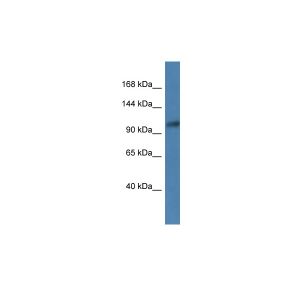
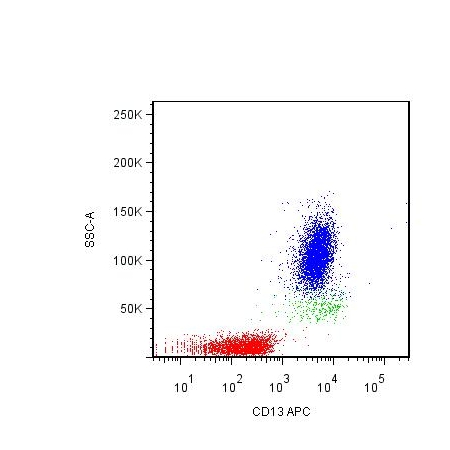
| Specificity | The antibody WM15 recognises the human CD13 cell surface glycoprotein, a 150 kDa molecule expressed on granulocytes, endothelial cells, epithelial cells and myeloid progenitors. HLDA III; WS Code M 213 HLDA IV; WS Code M 44 HLDA IV; WS Code M 209 HLDA V; WS Code M MA191 |
| Formulation | PerCP |
| Storage Buffer | The reagent is provided in phosphate buffered saline (PBS) containing 15 mM sodium azide and 0.2% (w/v) high-grade protease free Bovine Serum Albumin (BSA) as a stabilizing agent. |
| Reference | Favaloro EJ, Browning T, Facey D: CD13 (GP150; aminopeptidase-N): predominant functional activity in blood is localized to plasma and is not cell-surface associated. Exp Hematol. 1993 Dec;21(13):1695-701. Bradstock KF, Favaloro EJ, Kabral A, Kerr A, Hughes WG, Musgrove E: Myeloid progenitor surface antigen identified by monoclonal antibody. Br J Haematol. 1985 Sep;61(1):11-20. Bradstock KF, Favaloro EJ, Kabral A, Kerr A, Hughes WG, Berndt MC, Musgrove E: Human myeloid differentiation antigens identified by monoclonal antibodies: expression on leukemic cells. Pathology. 1985 Jul;17(3):392-9. McCormack E, Mujic M, Osdal T, Bruserud O, Gjertsen BT: Multiplexed mAbs: a new strategy in preclinical time-domain imaging of acute myeloid leukemia. Blood. 2013 Feb 14;121(7):e34-42. doi: 10.1182/blood-2012-05-429555. Leukocyte Typing III., McMichael A.J. et al. (Eds.), Oxford University Press (1987). Leukocyte Typing IV., Knapp W. et al. (Eds.), Oxford University Press (1989). Leukocyte Typing V., Schlossman S. et al. (Eds.), Oxford University Press (1995). Terauchi M, Kajiyama H, Shibata K, Ino K, Nawa A, Mizutani S, Kikkawa F. Inhibition of APN/CD13 leads to suppressed progressive potential in ovarian carcinoma cells. BMC Cancer. 2007 Jul 27;7:140. Petrovic N, Schacke W, Gahagan JR, O'Conor CA, Winnicka B, Conway RE, Mina-OsorioP, Shapiro LH. CD13/APN regulates endothelial invasion and filopodia formation. Blood. 2007 Jul 1;110(1):142-50. Tokuhara T, Hattori N, Ishida H, Hirai T, Higashiyama M, Kodama K, Miyake M. Clinical significance of aminopeptidase N in non-small cell lung cancer. Clin Cancer Res. 2006 Jul 1;12(13):3971-8. |
|---|---|
| Gene Symbol | ANPEP |
| Gene Full Name | alanyl aminopeptidase, membrane |
| Alias Symbols | alanyl (membrane) aminopeptidase, Alanyl aminopeptidase, aminopeptidase M, aminopeptidase N, AP-M, AP-N, APN, CD13, GP150, hAPN, LAP1, membrane alanyl aminopeptidase, microsomal aminopeptidase, myeloid plasma membrane glycoprotein CD13, P150, PEPN. |
| NCBI Gene Id | 290 |
| Protein Name | Aminopeptidase N |
| Description of Target | Broad specificity aminopeptidase which plays a role in the final digestion of peptides generated from hydrolysis of proteins by gastric and pancreatic proteases. Also involved in the processing of various peptides including peptide hormones, such as angiotensin III and IV, neuropeptides, and chemokines. May also be involved the cleavage of peptides bound to major histocompatibility complex class II molecules of antigen presenting cells. May have a role in angiogenesis and promote cholesterol crystallization. |
| Uniprot ID | P15144 |
| Protein Accession # | NP_001141.2; XP_005254949.1 |
| Nucleotide Accession # | NM_001150.2; XM_005254892.3 |